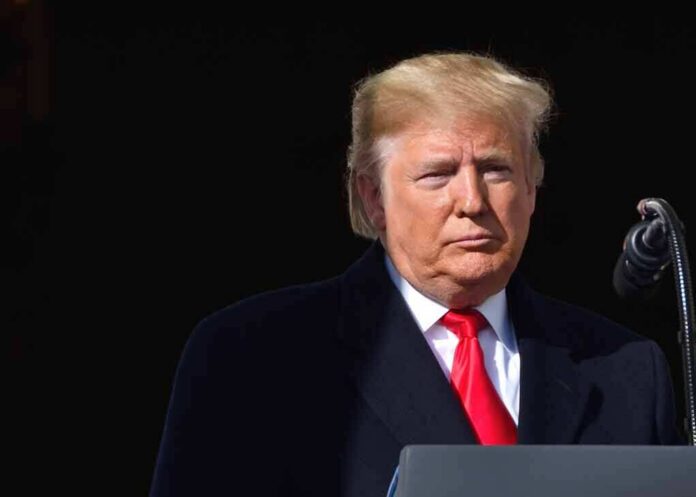
President Trump signed an order on a Nebraska rally stage to let drivers use tax-free red-dyed diesel and to pause the federal diesel tax through year-end, aiming to cut fuel costs now.
Story Snapshot
- Trump signed the order publicly in Grand Island, Nebraska.
- The White House says dyed diesel can be used on highways temporarily.
- Treasury is directed to defer federal diesel excise taxes through year-end.
- USDA projects about $640 million in combined savings across farm acres.
What The Order Does Right Now
President Trump’s executive order expands access to tax-exempt dyed diesel and opens it for highway use on a temporary basis. The White House says the order directs the Department of the Treasury to defer the federal excise tax on highway diesel through the end of the year, without interest or penalties. The order also instructs agencies and states to use discretion so dyed diesel can be used on public roads during this period. Reuters reported Trump signed it on stage in Grand Island, Nebraska.
The move targets the difference between two identical fuels. Dyed diesel is the same as clear diesel at the pump, but the government adds a red dye to mark it for off-road uses like farming and construction. That dye signals no highway taxes were charged. Federal highway use has long been barred for dyed fuel and penalized, which is why inspections and enforcement exist. The order loosens those limits for a set time while the tax deferral runs.
Who Benefits And How Much
The White House frames the action as relief for truckers and farmers who face high diesel bills. Trump told the crowd it would save a typical trucker more than $100 per fill-up and ease costs across the supply chain, touching groceries and goods. The United States Department of Agriculture said the action represents about $640 million in combined federal and state savings across roughly 224.6 million harvested acres, signaling material help for producers as they move crops to market.
Mechanically, drivers and fleets can buy dyed diesel and use it on highways during the relief window, while the federal diesel tax is deferred under the order’s direction to Treasury. Because dyed diesel skips the on-road tax at the terminal, the per-gallon price is normally lower than taxed fuel. That gap, plus the tax deferral, is the claimed savings. Industry basics remain stable: red dye tracks untaxed fuel, while enforcement focuses on stopping tax-free gallons from leaking into general highway use outside policy windows.
The Broader Fuel-Tax Pattern
Fuel policy uses a simple tool to sort who pays for roads. Regulators dye off-road diesel so highway inspectors can spot tax-free fuel in a truck tank. The Internal Revenue Service and state patrols use roadside checks and stiff fines to protect road funds. That guardrail matters because fuel taxes support maintenance of the roads heavy trucks use most. Temporarily allowing dyed diesel on highways and deferring the tax is a fast way to drop operating costs without changing the fuel itself.
8 AM Top-of-the-Hour News
Two commercial vessels have been attacked by drones in the Black Sea, off the coast of Bulgaria. One ship sank, and its crew is missing. European Commission President Ursula von der Leyen called the attacks on civilian shipping unacceptable.… pic.twitter.com/4gP1x8sgRa
— Worldwide News Network (@WorldwideNNX) October 6, 2026
Some coverage highlights uncertainty about how far the relief flows into store prices, but no one disputes the action taken, the signing location, or the government’s stated aim. The underlying logic tracks with common sense: shave the tax, open cheaper supply, and give working fleets a break. That lines up with conservative priorities of lowering costs, cutting red tape, and backing the people who move food, fuel, and freight. Agencies will handle the mechanics; drivers will feel the difference at the pump.
Sources:
nypost.com, whitehouse.gov, reuters.com, nytimes.com, cnn.com, usatoday.com, whio.com
© patriotnewsdaily.com 2026. All rights reserved.