Two B-1 bombers roared over a 100-foot red carpet as President Trump greeted China’s leader on the tarmac — and the optics battle began on the spot.
Story Snapshot
- Trump offered a rare tarmac welcome with a long red carpet, honor cordon, and flyover.
- Major outlets called it an uncommon break from protocol and a lavish scene.
- Republican China hawks warned the gesture risked legitimizing an adversary.
- Defenders said it was reciprocal statecraft, not deference or weakness.
The Unmistakable Scene at Joint Base Andrews
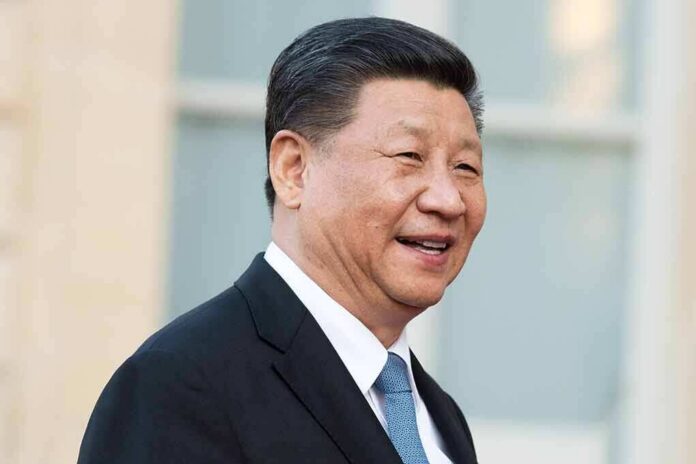
President Trump met China’s Xi Jinping at Joint Base Andrews with full pageantry. A 100-foot red carpet stretched along the tarmac. A military honor cordon lined the route. The United States Air Force band played as leaders shook hands. Two B-1 bombers conducted a flyover as the couples walked the carpet. The sequence looked designed for the camera and for history books. Few presidents greet foreign leaders on the runway. This one did — and added jets.
The images spread online within minutes. One clip showed United States service members on their hands and knees smoothing the carpet before the motorcade, which fueled the backlash trend line. The viral loop fixed the story around symbolism. That is how ceremonies work; the strongest picture wins. Critics argued that the shot list — the carpet, the honor cordon, the bombers — packaged parity with Beijing in a single frame. Supporters insisted the moment matched prior pomp and fair play.
Protocol Versus Perception: Why This Looked Different
News reports framed the tarmac greeting as rare. Protocol usually assigns airport duty to the chief of protocol or a cabinet official. The president then hosts the formal welcome at the White House. Trump mixed both tracks by meeting the plane and planning a large South Lawn ceremony later, with hundreds of service members and both flags displayed. That blend signaled elevation. Whether one sees strength or softness depends on what one thinks ceremony communicates in power politics.
Several outlets leaned on the “unusual” label. The Hill called the airport greeting rare and tied it to a “controversial” visit. Political Wire highlighted Bloomberg’s take that the tarmac sightline gave Beijing a peer-image opportunity. The BBC and the Guardian emphasized the red carpet length and the military flyover. The shared theme was not mystery. It was scale. A runway hello became a full tableau, which is not the standard welcome for rivals.
Conservative Concerns: Optics That Reward Bad Behavior?
Republican China hawks did not hold back. Senator Roger Wicker warned that the guest is “a brutal, unelected and oppressive dictator,” arguing that American ceremony should not blur that fact. That critique fits a common-sense test many conservatives use: do not confuse courtesy with credibility. If a hostile regime jails dissidents, threatens Taiwan, and steals technology, then the United States should not grant visuals that hint at equal values or shared purpose. Rituals send signals, and signals shape leverage.
🇺🇸🇨🇳BREAKING NEWS | TRUMP WELCOMES XI JINPING WITH RED CARPET, MILITARY HONORS
U.S. President Donald Trump personally welcomed Chinese President Xi Jinping at Joint Base Andrews, Maryland, as the Chinese leader arrived for a historic three-day state visit to the United States pic.twitter.com/3xKYMAW7Ww— SPIN MEDIA TV PHILIPPINES (@spinmediatv2026) September 24, 2026
Critics also noted the timing. Talks touched trade, Taiwan, and artificial intelligence. Those are core pressure points, not soft issues. Some said a runway spectacle risks telling Beijing that sharp edges will be met with soft gloves. Defenders replied that you can welcome a rival in uniformed splendor and still drive a hard bargain in the room. That is not a silly defense. Great powers often mask friction with formal respect so they can test deals without public chest-thumping.
The Reciprocity Rebuttal: Pomp As Policy Tool
White House allies pointed to a basic rule in diplomacy: reciprocity. Xi gave Trump grand treatment in China. Trump returned the favor here. They argued that matching ceremony is a tool, not a trophy — it buys face for the other side while setting a stage for asks and red lines. Supportive reports framed the scene as standard for a state visit: long carpet, band, honor cordon, anthems, and airpower pride. That counter reads the same images as leverage, not loss.
Both stories rely on the same facts. The difference lies in what pageantry means. If you see ritual as a mirror, then it reflects mutual standing and opens a path to business. If you see ritual as branding, then it stamps the moment with a message of parity that an adversary did not earn. The truth test will not come from the runway. It will come from outcomes on trade enforcement, technology theft, Taiwan stability, and military risk control. Pictures sell. Results count.
Bottom Line: Optics Matter, But Deliverables Decide
The welcome was rare, loud, and built for cameras. That is not in dispute. The backlash grew because the world saw United States power dress up a rival on a runway. That can look like magnanimity or like mixed signals. On the merits, conservative prudence says ceremony should serve strategy. If policy gains follow, the carpet was a cheap price. If not, the footage becomes a gift that Beijing did not pay for. The scoreboard is not the tarmac. It is the treaty text.
Sources:
mediaite.com, bbc.com, washingtonexaminer.com, nypost.com, politicalwire.com, thehill.com, bdnews24.com, malaymail.com
© patriotnewsdaily.com 2026. All rights reserved.