Paris shut two famed central zones at nightfall, turning a protest flashpoint into a no-go map.
Story Snapshot
- Paris police ordered an overnight curfew at Place de la République and Les Halles.
- The curfew ran late Monday to early Tuesday to block more riots and looting.
- Officials tied the order to recent violence and damage across French cities.
- Gatherings faced added limits citywide as authorities moved to restore calm.
Police draw a hard line after a violent weekend
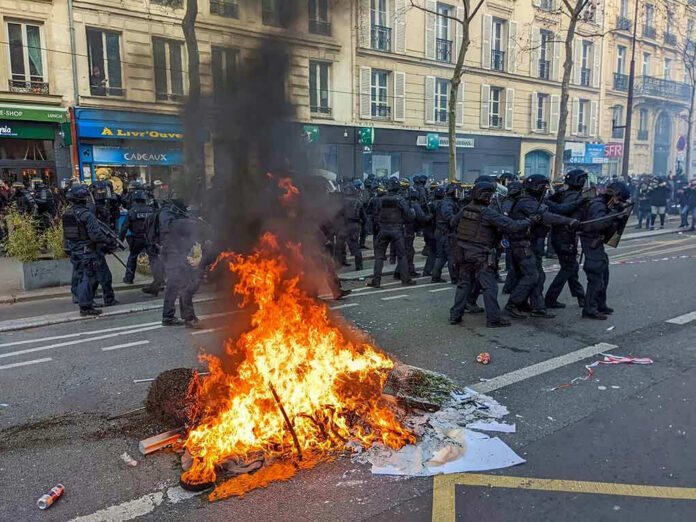
Paris police imposed a targeted curfew covering Place de la République and streets around Les Halles after a weekend of riots that hit public buildings and shops. The order barred people from entering or staying in those zones overnight, aiming to protect people and property from more violence and looting. The window ran from 11 p.m. Monday to 6 a.m. Tuesday in République, and similar hours around Les Halles, according to multiple outlets citing the police prefecture.
National leaders framed the move as part of a wider push to restore order after unrest in several cities. Reports described fires, smashed storefronts, and attacks on local offices across France. Paris authorities limited assemblies citywide starting Monday evening, adding another layer to the effort to cut the risk of late-night clashes and smash-and-grab theft in crowded commercial areas.
The curfew’s scope and what it changed on the ground
The curfew focused on two central areas that drew crowds and saw trouble. Place de la République has long served as a rally point for marches. Les Halles draws heavy foot traffic, late shoppers, and tourists. Police cut the night flow to deny groups a base and to give cleanup crews and shop owners a clear window to secure property. The order sent a blunt message: after dark, those zones belong to emergency services, not mobs.
Officials stopped short of a citywide shutdown. They chose a narrow map and short timeline, likely to pass France’s proportionality test for administrative police powers. The limited scope offers two gains. First, it puts resources where risk is highest. Second, it avoids punishing quiet neighborhoods that saw no unrest. That approach mirrors how French leaders often handle urban disorder: fast, local, and temporary.
Will a short, tight curfew work?
Research on curfews is mixed and leans toward youth rules, not adult-wide emergency orders. Reviews in the United States show weak proof that curfews reduce youth crime. Some studies report little or no drop in offenses tied to such limits. Other work claims targeted curfews can reduce violent and property crimes among minors, but that finding does not settle adult outcomes during riots. Policymakers often choose curfews anyway because they are visible, simple, and fast to enforce.
That gap between theory and practice leaves results to the details: timing, clarity, and credible enforcement. Paris checked those boxes. The order named exact streets, set clear hours, and linked the move to the weekend’s damage. That helps police warn good-faith residents and isolate bad actors. It also signals to business owners that the state will guard core retail arteries. On balance, that aligns with a common-sense view that order is the first freedom; safety unlocks every other right.
Balancing public order and free assembly under French law
French authorities can restrict movement and gatherings when risks spike, but measures must be necessary and proportionate. The country’s framework allows prefects to regulate circulation in targeted zones when they cannot assure safety with routine means. Leaders reserved nationwide emergency powers and instead used a narrow curfew tool, consistent with this logic and with recent official guidance favoring partial curfews over sweeping declarations.
Critics often warn that curfews chill assembly. The Paris order tried to reduce that risk by limiting both geography and time. One night in two hotspots is not a blank check. The test comes next: Did the curfew stop looting and let police reset the streets? If quiet holds, it will strengthen the case for fast, local curfews in future spikes. If not, leaders may reach for sharper powers. For now, Paris bet on a narrow fix to keep the heart of the city from breaking again.
Sources:
youtube.com, abcnews.com, france24.com, cbsnews.com, cnn.com, newsukraine.rbc.ua, lcp.fr, academia.edu, en.wikipedia.org, cambridge.org
© patriotnewsdaily.com 2026. All rights reserved.