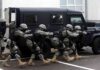
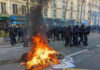
Forty pounds of fentanyl doesn’t just poison a neighborhood—it tests whether a city can take back a park in broad daylight and keep it.
Quick Take
- Federal and local agents executed “Operation Free MacArthur Park” on May 6, 2026, aiming to dismantle an entrenched open-air drug market.
- Authorities announced 18 arrests, with 25 defendants named in a federal complaint and 7 suspects still being sought.
- Agents seized roughly 40 pounds (about 19 kilograms) of fentanyl valued at more than $10 million, alongside enforcement targeting methamphetamine distribution.
- Investigators documented 27 drug deals during a March 9–April 15 investigation window, then hit nine search warrants across multiple Southern California locations.
A Park Becomes a Marketplace, Then a Battleground
MacArthur Park sits in dense central Los Angeles near the Alvarado Corridor, with transit access and constant foot traffic—exactly the ingredients that make open-air dealing durable. On May 6, federal agents and LAPD officers moved in with scale meant to signal permanence: more than 300 personnel, coordinated warrants, and a public message that the park would be “reclaimed.” The real question isn’t whether arrests happened. It’s whether control holds after the cameras leave.
Operations like this always carry two clocks. One is the enforcement clock: simultaneous searches, quick handcuffs, evidence seizures, and headline numbers. The other is the community clock: whether parents return, whether seniors sit again, whether local businesses stop treating the sidewalk like a hazard zone. When officials frame a raid as returning a “public space to the citizens,” they admit an uncomfortable truth—government had effectively ceded ground, and residents felt it.
How the Case Was Built: Surveillance First, Then a Sudden Sweep
Investigators documented 27 separate drug deals between March 9 and April 15, 2026, then executed the operation weeks later. That sequencing matters because it suggests planning for more than street-level busts. The May 6 action included nine search warrants: six in the MacArthur Park area and three spread across Calabasas, San Gabriel, and South Los Angeles. That geography points to a supply chain, not a single corner crew improvising day to day.
The seizure figure—around 40 pounds of fentanyl—drives home why federal agencies lead these efforts. Street dealers rarely hold that quantity, and users rarely buy in bulk. Authorities tied major supply roles to individuals accused of distributing fentanyl powder, methamphetamine, or both, with key figures described as operating on behalf of the 18th Street Gang. Federal charges for possession with intent to distribute can carry crushing sentences, especially for alleged suppliers.
The Gang Nexus and the Logic of Taking Down “Suppliers”
Officials identified accused suppliers including Mallaly Moreno-Lopez and Jackson Tarfur, described as primary sources for the MacArthur Park market, and Yolanda Iriarte-Avila, described publicly as the park’s “No. 1 drug trafficker,” with a Calabasas location tied to stash activity. When law enforcement targets suppliers, they aim to raise cost and risk upstream. That is the only strategy that can outpace a street market that replaces low-level sellers overnight.
Claims about cartel-connected trafficking hovered over the operation, and that focus tracks with the national fentanyl problem: synthetic opioids move efficiently, profitably, and at lethal potency. Conservative common sense says accountability must track harm; moving lethal product at scale is not a “quality of life” offense. A serious operation treats bulk suppliers as the central danger, not as background characters. The open loop here is whether the 7 wanted suspects represent missing links higher up—or simply the next set of sellers.
Why Officials Stressed “Not an Immigration Operation”
Authorities explicitly said the raid was not an immigration operation, a line that reveals today’s political terrain as much as it does the case facts. Leaders likely wanted cooperation from residents who fear that any federal presence equals immigration enforcement. Separating drug enforcement from immigration helps isolate traffickers from the communities they hide within. The conservative lens is practical: law enforcement succeeds when witnesses talk, victims seek help, and criminals lose the ability to use fear as a shield.
That clarification also speaks to legitimacy. A park crackdown earns public support when it looks targeted, lawful, and focused on traffickers rather than sweeping up bystanders. Search warrants, documented buys, and a federal complaint naming defendants create a paper trail that can withstand scrutiny. People over 40 have seen “cleanups” come and go; the ones that last show receipts. This operation, at least on paper, tried to bring them.
What Happens Next: The Market Moves, or the City Holds the Line
The short-term effect of a big sweep is usually quiet—then adaptation. Dealers shift a few blocks, move to delivery models, or recruit new sellers. That’s why a reclaimed park requires follow-through: visible patrols, consequences for returning dealers, and a city willing to keep pressure on the same territory for months, not days. The best-case outcome pairs enforcement with a physical reset—cleaning, lighting, programming, and steady presence that makes dealing inconvenient.
The operation’s numbers sound decisive—18 arrests, 25 defendants, a fentanyl haul valued over $10 million—but the long game is measured in whether the park becomes normal again. Seven suspects still at large also means the story isn’t finished; loose ends often pull a market back together if ignored. Los Angeles can’t arrest its way out of addiction, but it can refuse to subsidize lawlessness in public spaces that families already paid for.
MacArthur Park now becomes a stress test for policy: can leaders protect ordinary citizens without excuses, keep enforcement focused on traffickers, and sustain control long enough for community life to reappear? If that sounds basic, it is. Basic is what cities owe taxpayers. The fentanyl trade thrives where government gets tired; the operation’s real verdict arrives later, when the park either stays open for families—or reopens for dealers.
Sources:
Feds conduct raid at MacArthur Park
MacArthur Park Drug Raid Uncovers 40 Pounds of Fentanyl; 18 Arrested