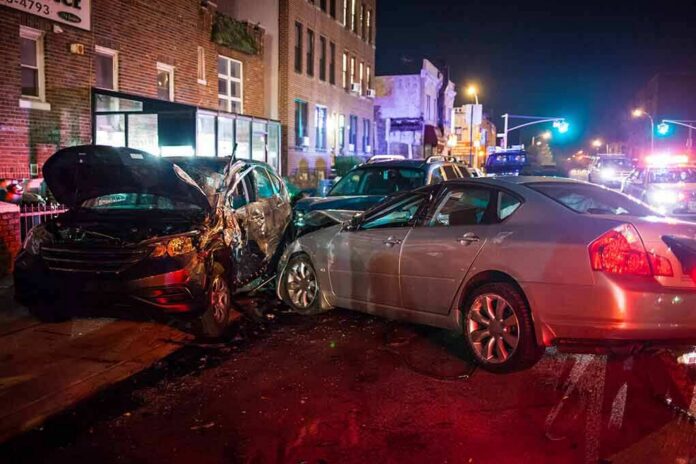
A Sunday drive to church ended with a hit-and-run crash that sent one of Congress’s longest-serving Democrats to the hospital and left a fleeing driver somewhere out on the streets of Toledo.
Story Snapshot
- Representative Marcy Kaptur was hospitalized with non-life-threatening injuries after a hit-and-run crash in Toledo.
- Her office says she was a passenger in a car headed to church when another vehicle struck them.
- Toledo police report two people went to the hospital and are still investigating the missing driver.
- Local coverage shows how fast official statements can set the story before all facts are nailed down.
A longtime congresswoman, a Sunday routine, and a sudden crash
Representative Marcy Kaptur, an 80-year-old Democrat from Toledo and the longest-serving woman in the history of the United States House of Representatives, was not doing anything dramatic on that Sunday morning. She was riding in a car, heading to a church service, the kind of routine many voters know well. That routine shattered at the intersection of Detroit Avenue and Central Avenue around 10:45 to 10:48 a.m., when another vehicle hit the car she was in and then fled the scene.
Her office moved quickly to calm fears. Spokesman Ben Kamens said Kaptur was a passenger when the car she was traveling in was struck and described her as “active, alert, and being treated for non-life-threatening injuries.” That short phrase did a lot of heavy lifting. It signaled she was conscious. It said the crash was serious enough for hospital care but not life-threatening. And it framed the event as a hit-and-run, a loaded term that tells the public someone chose to leave instead of stay and face responsibility.
Police facts, witness details, and what we still do not know
Toledo Police Sergeant Mohamad Nasser confirmed two people were transported to a nearby hospital and said officers treated the collision as a “hit-skip” crash, a local term for hit-and-run. Police said the injuries were not considered life-threatening and made clear their investigation was in its early stages. A witness, Morgan Valley, told reporters she heard the crash, called 911, and saw paramedics remove a woman from the car before taking her to the hospital.
Another witness told a local television station the fleeing driver was picked up by a second vehicle and left soon after the crash. That detail paints an even harsher picture of intent: not just panic and flight, but a planned getaway with help. Yet, police have not publicly confirmed that specific claim, and the official record so far does not name the suspect or explain exactly how the vehicles collided. For now, those vivid witness scenes sit alongside a sparse set of formal facts, waiting for the crash report, video footage, and follow-up interviews that can tighten the story.
How a simple statement becomes the settled narrative
News outlets from Fox to NBC to local Toledo stations all repeated the same core points within hours: Kaptur was a passenger, on her way to church, hospitalized with non-life-threatening injuries after a hit-and-run; two people went to the hospital; police are still looking for the other driver. Most coverage drew from the same small pool of information: Kaptur’s office, a Toledo police spokesperson, and one or two eyewitnesses.
That is how breaking-news stories about political figures usually harden. A single official statement sets the frame. Reporters, under deadline, echo it. Local television adds dramatic language and witness color. By nightfall, the story feels fully confirmed even though key documents—the crash diagram, medical records, and identified suspect—are not yet public. In this case, there is no competing “Side B” narrative claiming she was driving, that she was not headed to church, or that the crash was minor. The only real tension lies in what has not been filled in yet.
Responsibility, law and order, and the values at stake
From a common-sense and conservative view, the core problem is simple: a driver hit a car carrying a public servant and another person, then ran instead of facing the consequences. That choice rejects basic personal responsibility. It puts everyone at more risk, from police who have to hunt the suspect to the public that now worries about a hit-and-run driver still out there. Law-and-order values say you stay at the scene, you cooperate, and you accept the outcome, even if you fear a ticket or a charge.
The quick, grateful tone of Kaptur’s office—thanking first responders and looking forward to returning to a full schedule soon—matches another deeply American instinct: respect for police, firefighters, and medical staff who show up when normal life breaks. At the same time, this case shows why voters should not let early headlines be the last word. Important questions remain: Who was the fleeing driver? Was there a second car involved in the escape? What exactly were the injuries to Kaptur and the other hospitalized person?
Sources:
redstate.com, youtube.com, thehill.com, toledoblade.com, newser.com, washingtonexaminer.com, wfin.com
© patriotnewsdaily.com 2026. All rights reserved.