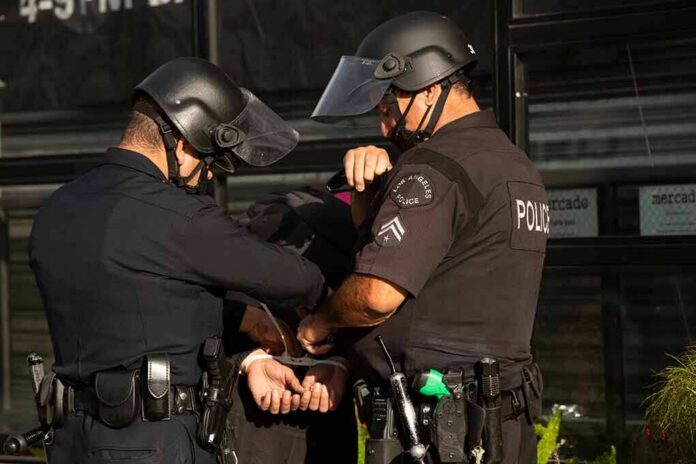
Two clashing truths met on a Mexico City sidewalk: a hotel alarm about violence, and a street claim of police abuse caught on video.
Story Snapshot
- Police say they responded to a hotel emergency and detained two people after damage and an attack with a fire extinguisher.
- Video shows officers pinning a transgender sex worker to the ground as bystanders shout about abuse.
- Local outlets describe a protest over alleged discrimination at the hotel that included graffiti and broken glass.
- Human-rights records show a long pattern of police harassment of transgender sex workers in Mexico City.
What Sparked The Confrontation On Bolívar Street
Mexico City’s Secretariat of Citizen Security said officers answered an emergency call from a hotel on Bolívar Street in Colonia Obrera. Staff reported two workers were attacked with a fire extinguisher, and the property was damaged. Police requested backup and, after several minutes, detained two individuals who identified as part of the lesbian, gay, bisexual, transgender, queer community. Hotel staff pointed to them as responsible for the harm and damage, according to press accounts that quote the police version.
Video from the scene shows officers forcing a transgender sex worker onto the pavement as people in the crowd yell that police are hitting her. During the struggle, the person on the ground swats at officers and appears to bite one of them, as reporters later described from the clip. A bystander calls the detainee a trans woman and tells police to stop rough handling her. The video captures the takedown, not the lead-up or the first contact with officers.
Why This Street Clash Feels Familiar In Mexico City
Human-rights reporting has, for years, documented how police and local rules can be used to target or shake down transgender sex workers. Shadow reports and academic work cite extortion, pretext arrests, and verbal abuse. Researchers describe officers asking for money or sexual favors, and using ambiguous local codes as leverage. That record does not prove what happened on Bolívar Street, but it explains why many viewers default to doubt when they see a hard takedown of a trans woman on video.
Local coverage also set the scene beyond the sidewalk brawl. Hours before or around the time of the confrontation, outlets described a protest by transgender sex workers on Calzada de Tlalpan over alleged discrimination at the Hotel Encanto. Reporters noted graffiti and broken glass at the site. That context matters because it shows a dispute that had already turned tense and property had been damaged before the police-lodged account of an assault with a fire extinguisher entered the picture.
The Hard Questions About Force, Law, And Accountability
Mexico City law grants officers wide discretion to detain without a warrant when they see a possible offense. That power can help stop real harm fast, like a brawl or vandalism. It also creates risk when officers operate in gray zones, especially with stigmatized groups. The video raises a narrow but vital question: was the force used on the pavement necessary to secure a resisting suspect, or did it cross the line into punishment? One clip cannot settle that call.
Here is what stacks up under common sense and conservative values. Property rights and public order matter. If people assaulted workers and wrecked a business, police should step in and end it. But the badge does not erase the Constitution. Officers must use only the force needed to control a suspect and then hand the person to a judge. The best path now is simple and strict: release the full incident report, preserve and review all body camera footage, and disclose injuries and charges. Sunlight serves both the shopkeeper and the citizen on the ground.
How To Keep The Next Call From Becoming A Street Trial
Clear protocols and clear cameras decide these cases before they explode. Supervisors should audit body camera footage after any force event, and publish summaries when public trust is at stake. Commanders should deploy liaison teams trained to manage protests that include sex workers, so officers do not improvise tactics under stress. City leaders should brief hotel managers on rapid complaint channels that do not escalate tempers at the door. None of that is ideology. It is basic risk control that protects lives, jobs, and due process.
Sources:
youtube.com, nswp.org, transgenderlawcenter.org, oas.org, gaatw.org, proceso.com.mx
© patriotnewsdaily.com 2026. All rights reserved.