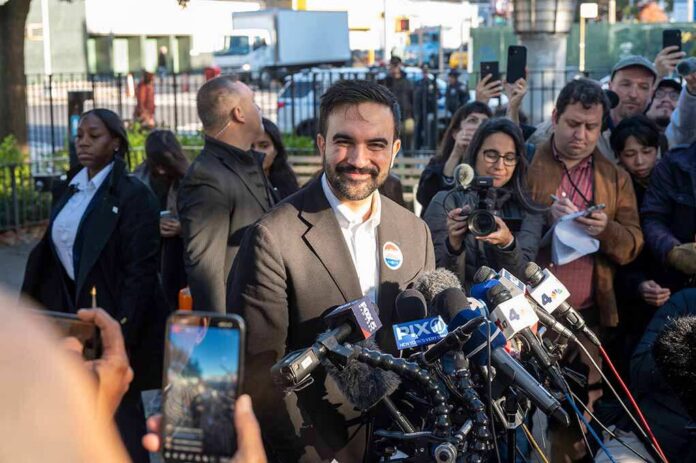
On a day set aside to mourn Hamas’s Oct. 7 massacre, New York City’s mayor used the word “genocide” for Israel and lit a fuse that exploded across two continents.
Story Snapshot
- Mamdani’s Oct. 7 statement mourned Israeli victims, then condemned Israel’s Gaza war as “ongoing genocide.”
- Israel’s Foreign Ministry blasted him as a “mouthpiece for Hamas propaganda.”
- Jewish and pro-Israel voices said he politicized a memorial day to attack Israel.
- Prior statements show a pattern of pairing Oct. 7 grief with sharp Israel criticism.
The Trigger: One Phrase That Reframed a Memorial
The official Oct. 7 message from New York City Mayor Zohran Mamdani opened with clear blame on Hamas for “horrific war crimes,” honoring the Israeli dead and hostages. Then the pivot came. He said the “suffering did not begin nor end that day,” and called Israel’s Gaza campaign an “ongoing genocide.” The city’s own posting put that sequence in black and white, matching reproductions by local media. The pairing set the frame for the storm that followed.
Words matter, but order matters more. Commemoration messages from world leaders often focus on victims, terror, and antisemitism. Mamdani broke that script by jumping from mourning to labels like “genocide,” “apartheid,” and “war crimes.” That choice guaranteed a backlash because it moved the tonal center from solidarity with victims to an indictment of Israel’s conduct. Critics did not have to argue context; the sequence handed them the case that he used a grave day to prosecute a political brief.
The Backlash: Jerusalem Fires, New York Boils
Israel’s Foreign Ministry attacked his message in striking terms, accusing him of boosting Hamas talking points and normalizing antisemitism. That official blast gave the controversy a global frame and amplified it in U.S. media. Tabloids and pro-Israel outlets said he gave only a few lines to Jewish grief before turning the day into an anti-Israel screed. The reaction made his phrasing the story, not his opening condolences, and locked him into days of defense.
Network and local coverage described the same core facts: he mourned Israeli victims, then condemned Israel and the United States for policy. Supporters called that balance; opponents called it a breach. The narrative hardened fast because it matched prior notes in his record. Past statements tied peace to ending occupation and dismantling apartheid. That pattern gave critics an easy link: this was not a slip, they argued, but his brand. Voters saw a line, not a dot.
The Stakes: Words, Timing, and the Mayor’s Burden
New York carries the largest Jewish population outside Israel. On Oct. 7, that fact raises the bar for tone and timing. Leaders can condemn Hamas and debate Israel policy on any day. On this day, many citizens expect a clear, unqualified stand with terror victims and a stand against antisemitism, full stop. The mayor chose a different route, and that turned grief into a referendum on speech norms. That is not censorship; it is civic expectation in a wounded city.
𝐌𝐀𝐌𝐃𝐀𝐍𝐈 𝐒𝐏𝐄𝐍𝐃𝐒 𝐌𝐎𝐒𝐓 𝐎𝐅 𝐇𝐈𝐒 𝐎𝐂𝐓𝐎𝐁𝐄𝐑 𝟕 𝐒𝐓𝐀𝐓𝐄𝐌𝐄𝐍𝐓 𝐀𝐓𝐓𝐀𝐂𝐊𝐈𝐍𝐆 𝐈𝐒𝐑𝐀𝐄𝐋, 𝐍𝐎𝐓 𝐌𝐎𝐔𝐑𝐍𝐈𝐍𝐆 𝐇∗𝐌𝐀𝐒’ 𝐕𝐈𝐂𝐓𝐈𝐌𝐒
Three years to the day since H∗mas stormed the border and m∗rdered more than 1,100 Israelis, New York City… pic.twitter.com/gXvBraFPLr
— M.A. Rothman (@MichaelARothman) October 7, 2026
American conservative values prize moral clarity and respect for the dead. By injecting “genocide” into a memorial message, the mayor guaranteed the headline would eclipse his first lines about Hamas’s crimes. That is not strategic leadership. It reads as rhetorical escalation on the one day when restraint carries the highest premium. If he wanted a policy debate, he had six hundred other days. On this day, many expected the mayor to close ranks, not open new fronts.
What Holds Up, What Does Not
The text supports two firm points. First, he did mourn Israelis and call Hamas’s attack a war crime. Second, he then condemned Israel’s Gaza war as “ongoing genocide” and used terms like “apartheid” and “war crimes.” Those choices drove the reaction and fit a longer pattern in his public remarks. The record does not show an explicit slur against Jews in the statement. The charge of antisemitism rests on timing, labels, and effect, not on direct insult.
Leadership is judgment under pressure. On the third Oct. 7 since the massacre, words were the test. The mayor’s words split the audience he most needed to reassure. That is the lesson here for any official in a plural city: sequence signals respect. Say the memorial part like you mean it. Then, on another day, argue the policy part with facts and care. Switch the order on Oct. 7, and you do not just lose the room—you give the room a reason to walk out.
Sources:
thegatewaypundit.com, fox5ny.com, reddit.com, politico.com, cnn.com, redstate.com, washingtonexaminer.com, gov.uk
© patriotnewsdaily.com 2026. All rights reserved.