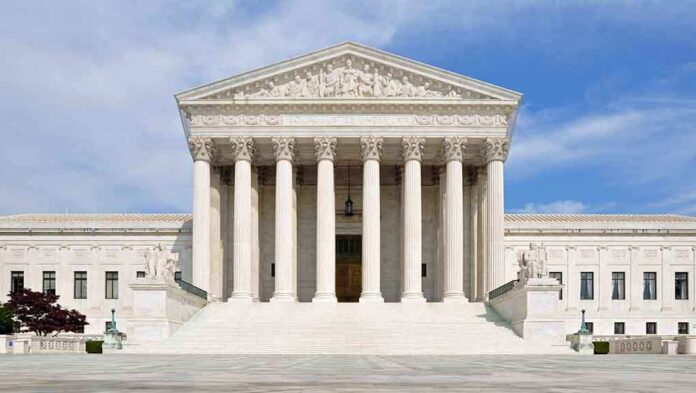
One quiet Supreme Court sentence just blew a hole in how blue states try to erase your right to carry a gun in everyday life.
Story Snapshot
- Hawaii made it a crime to carry on most private property open to the public unless owners gave explicit permission.
- The Supreme Court rejected that default no-gun rule and said it “hobbles” what the Second Amendment protects.[3]
- The case, Wolford v. Lopez, now defines how far states can go using property rules to choke off public carry.[3]
- The ruling reaches far beyond Hawaii and puts copycat laws in other states on the chopping block.[3]
Hawaii Turned Everyday Places Into Gun-Free Zones By Default
Hawaii did something simple and powerful: it flipped the default. The law said no one with a carry permit could bring a handgun onto private property open to the public unless the owner gave “unambiguous” permission by clear signs or direct approval.[1] Think grocery stores, gas stations, malls, hotels, even many workplaces. If the owner stayed silent, you were a criminal the moment you stepped in with your lawfully carried gun.[5] Gun owners argued that turned normal life into a legal minefield.[7]
Petitioners in Wolford v. Lopez, three Maui residents and the Hawaii Firearms Coalition, told the Court the rule “effectively nullifies” carry licenses in public.[7] They pointed out most owners do not post signs, and modern life means you constantly cross private property open to the public. Combined with Hawaii’s long list of “sensitive places,” they estimated carry was barred or presumptively barred on over 96 percent of publicly accessible land.[4] Their basic claim was common sense: a right you cannot use in real life is no right at all.
Supreme Court Said The State Cannot Steal Owners’ Choice And Call It Property Rights
Hawaii’s defense leaned hard on property rights. The state argued the Second Amendment does not include a right to enter someone else’s land with a gun against that owner’s rules.[3] In their view, the law simply enforced the owners’ “right to exclude” armed visitors and did not really regulate Second Amendment conduct. The Ninth Circuit bought that logic and reinstated the law after a district judge blocked it, saying the rule fit within gun regulation tradition.[3]
The Supreme Court saw something very different. The majority held that Hawaii’s law plainly restricts “bearing arms” covered by the Second Amendment’s text.[6] Justice Samuel Alito wrote that the rule “hobbles what the Amendment protects” by making carry illegal almost everywhere unless private owners override a state-imposed no-gun preference.[3] That framing matters. The Court did not say property rights disappear. It said the state cannot pre‑decide for every owner that their property is gun‑free and then use criminal law to enforce that choice they never personally made.[6]
Bruen’s History Test Leaves No Room For Creative End Runs Around Public Carry
Under New York State Rifle & Pistol Association v. Bruen, when the Second Amendment’s text covers someone’s conduct, the government must justify restrictions with a clear tradition of similar gun rules from early American history.[25] Hawaii could not point to any historic law where government set a default no‑carry rule on private property open to the public. It leaned instead on general property principles and a few hunting and Black Code examples that did not match the modern rule’s scope.[1]
The challengers hammered that gap. They argued there is “no comparable historical—or even modern-day—tradition” of letting government impose no‑gun defaults on open private property.[1] A federal amicus brief agreed, saying Hawaii’s approach “effectively nullif[ies]” the public carry right recognized in Bruen.[6] In post‑Bruen litigation, courts have often struck down laws that destroy carry rights through clever devices like consent rules or massive “sensitive place” lists when no founding-era analogue exists.[19] Hawaii’s law fit that pattern a little too perfectly.
What This Ruling Means For Other States, Businesses, And Gun Owners
The Court’s decision went beyond one island chain. By rejecting Hawaii’s default rule, the justices signaled that states cannot use property‑consent tricks to gut carry rights while claiming they are “only” protecting owners. Reporting on the ruling notes that similar laws or proposals in states like California and New York now face serious constitutional problems.[3] For gun owners, the message is direct: if you have a valid permit, the default is that you may carry, unless a specific property owner clearly says otherwise.
SCOTUS struck down the law that Hawaii had that blanket prohibited firearms in private businesses held open to the public without specific permission (signage or verbal) that welcomed firearms.
By striking down this law, by default, Hawaiians can enter a private business with…
— Ryan Knoll (@ryknoll3) June 25, 2026
For businesses, the ruling draws a clean line. Owners still hold the power to set their own rules. They can post “no guns” signs or tell customers they may not carry on the premises. But that choice must be theirs, not the state’s decision forced on them by criminal law. That aligns with core conservative values: real property rights, real individual rights, and a government that cannot quietly erase either by flipping a default. States that ignore that lesson will likely see more of their laws fall.
Sources:
[1] Web – SCOTUS Overturns Hawaii’s Default Rule Against Guns on Private …
[3] Web – [PDF] brief – In the Supreme Court of the United States
[4] Web – [PDF] IN THE SUPREME COURT OF THE STATE OF HAWAI’I —o0o
[5] Web – Hawaiʻi AG To Supreme Court: Gun Control Is Hawaiian Tradition
[6] Web – What’s at Stake in Wolford? Supreme Court Grants Cert to Review …
[7] Web – LISTEN: Supreme Court hears case on law banning guns … – PBS
[19] YouTube – Supreme Court to Decide Private Property Gun Ban Case — Hawaii Law …
[25] Web – [PDF] Second Amendment Federalism – Stanford Law Review
© patriotnewsdaily.com 2026. All rights reserved.