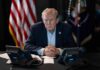
Donald Trump says if Iran ever succeeds in killing him, American bombs will answer the attack inside Iran.
Story Snapshot
- Israel shared intelligence that Iran devised a new plan to assassinate Trump.
- U.S. agencies took the warning seriously enough to boost Trump’s security.
- Trump publicly claims he left instructions to bomb Iran if he is assassinated.
- The episode sits inside a long, dark history of political violence and foreign plots.
Fresh Israeli Intelligence And A Chilling Warning
Israeli intelligence officials recently told the United States that Iran had devised a new plan to assassinate President Donald Trump, according to people familiar with the matter. The report described Iranian officials considering a specific scheme, not just angry talk, and landed in Washington as a fragile ceasefire between the United States and Iran was already under strain. This new warning came on top of years of Iranian vows to avenge Trump’s 2020 decision to kill top general Qassem Soleimani in a drone strike.
American intelligence services had already been hearing a steady drumbeat of chatter about possible plans to assassinate Trump, officials said, but the Israeli report stood out because it claimed a concrete plot. At the same time, some U.S. officials quietly suggested the intelligence might also be meant to push Trump toward tougher military action against Iran. That mix—real danger and possible political motive—captures how modern threats often come wrapped in strategy, not just violence.
Secret Service Adjusts And Trump Raises The Stakes
After the warning, the United States Secret Service surged resources to protect the former president, according to testimony given to Congress about Iranian threats against Trump. Agents reevaluated routes, assets, and security posture, treating the plot as serious enough to justify extra layers of protection. This response fit a broader pattern: federal agencies have long warned that Iran may try to target Trump and other senior officials in revenge for Soleimani’s death. Intelligence tracking showed multiple actors talking about attacks, even if none had yet moved from talk to action.
Trump, for his part, did not downplay the danger. He told reporters he was “Number One on the kill list for Iran” and said he had recently seen intelligence ranking him at the top of Iranian assassination priorities. Then he went further. In later comments reported by The Hill, Trump said he had left instructions that if Iran ever assassinated him, the United States should bomb targets inside Iran as retaliation. That is an extraordinary claim: a former president publicly tying his own life to future American military strikes.
Iran’s Global Reach And A History Of Plots
The idea of Iran trying to kill American political figures is not just theory. A federal jury recently convicted an Iranian intelligence operative named Asif Merchant for murder for hire and terrorism in a foiled plot inside the United States. Merchant admitted that Iran’s Islamic Revolutionary Guard Corps sent him to America to arrange political assassinations and steal sensitive documents, though undercover officers stopped him before any attack. That case showed Iran’s willingness to move from angry rhetoric to real operations on U.S. soil when it sees an opportunity.
American history also shows how rare but devastating successful political assassinations can be. Research for Congress documents 15 direct assaults against presidents, presidents-elect, and major candidates, with five resulting in death. Those killings reshaped the nation each time, from Abraham Lincoln to John F. Kennedy. Analysts at West Point point out that political assassinations are more likely when a country faces deep polarization and unstable power struggles, conditions that also describe much of today’s global climate. These patterns make foreign plots feel less distant and more like part of a wider storm.
Modern Political Violence And Conservative Concerns
Recent years have brought an uptick in political violence and threats across the United States, including attempts on Trump’s life and attacks on other conservative figures. A New York Times review found that Trump has faced more direct assassination attempts than recent predecessors, even as most political violence still comes from a relatively small fringe. Libertarian researchers at the Cato Institute stress that politically motivated murder remains uncommon overall, even though thousands have died in such attacks over many decades. That mix—rare but real—keeps tensions high without turning the country into a war zone.
The Israeli/US intelligence cooperation shared the most recent reported Iranian plot to assassinate President Donald Trump comes from intelligence shared by Israel with the U.S. in the past week (around July 9, 2026).
According to reports from The Wall Street Journal and CNN… pic.twitter.com/sJteNFyAJb
— RealPastorMark (@mark_pasto64312) July 10, 2026
From a conservative, common-sense view, Trump’s vow of automatic retaliation fits a simple logic: deterrence works when enemies believe crossing a red line will bring pain. Iran’s leaders understand force, not word games, and clear consequences can help protect American lives. Still, some officials worry about tying military decisions to the fate of one man, even a former president. The hard truth is that foreign regimes now treat U.S. political figures as battlefield targets, and Washington must decide how sharply it is willing to answer.
Sources:
townhall.com, timesofisrael.com, wsj.com, youtube.com, fox32chicago.com, common.usembassy.gov, pbs.org, brookings.edu, cato.org, ebsco.com
© patriotnewsdaily.com 2026. All rights reserved.