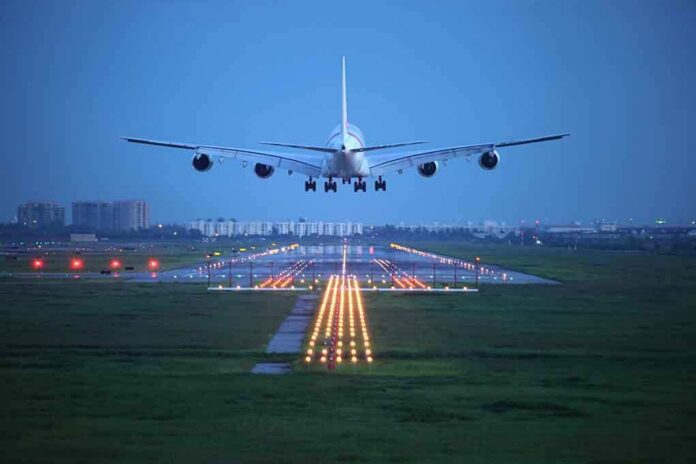
A fully loaded Boeing 767 cargo jet ran off a Miami runway, hit vehicles, and left five people dead.
Story Snapshot
- A Boeing 767-300 arriving from San Juan overran a runway at Miami International Airport around 2 p.m.
- Officials reported five dead and five injured after the jet struck vehicles and caught fire.
- About 200 first responders battled flames, fuel leaks, and complex rescues.
- Federal investigators opened a full runway excursion investigation; cause not yet determined.
What Happened On The Ground
Federal Aviation Administration officials said a Boeing 767-300, operating as an Amazon-linked cargo flight from San Juan, overran the runway at Miami International Airport around midafternoon. The aircraft broke through the end of the paved surface and struck vehicles near the airport perimeter before catching fire, sending a thick column of smoke into the sky. Miami-Dade officials said five people died and five suffered injuries during the crash and the fire that followed. Early reports did not name the victims.
Miami-Dade Fire Rescue deployed roughly 60 units and nearly 200 personnel, according to public briefings. Crews faced burning fuel, mangled wreckage, and trapped occupants. They used foam to blanket jet fuel, cut through twisted metal, and worked side by side with law enforcement to secure the perimeter. The scene stretched across airport property and adjacent roadways, complicating access and triage. The unified command balanced fire suppression, patient transport, and a rapid shift to evidence preservation.
How The Airport Responded
Airport operations slowed at once. Officials ordered closures of at least one runway and nearby taxi routes, which triggered delays and diversions. Airlines re-sequenced arrivals as controllers protected the crash area and kept rescue corridors clear. Pilots taxied along modified routes, while inbound flights held or diverted to nearby fields. Normal traffic depended on clearing debris, evaluating pavement damage, and securing remaining fuel hazards before any runway could reopen for traffic.
Ground stops after a runway excursion follow a clear logic: protect lives, preserve evidence, and stabilize the field. Crews must verify lighting, signage, and pavement integrity. They must also confirm that fire-retardant foam and runoff do not create braking hazards for later arrivals. That checklist takes time, and each item matters more than a schedule board. Airlines can replace flights. Families cannot replace people. The airport treated it that way from the first alarm.
What Investigators Will Seek
The National Transportation Safety Board and the Federal Aviation Administration launched a joint probe into the runway excursion. Investigators will recover flight data and cockpit voice recorders, review maintenance logs, inspect brakes and thrust reversers, and analyze weight and balance paperwork. They will compare air traffic control records with touchdown point, speed, and deceleration data. Weather, runway condition, and crew decision-making will be examined with equal care. The agencies called this a runway excursion, a defined accident class.
Runway excursions are among aviation’s most common serious events. They occur in cargo and passenger operations alike and can stem from late touchdown, wet pavement, system faults, or pilot error. Prior cases show the pattern: when fast, heavy, and long on the rollout, distance disappears fast. That is why airports invest in longer safety areas and arrestor beds when they can, and why crews brief “land within the zone or go around” on every approach. The label is dry; the stakes are not.
The Amazon Cargo Context
Public attention sharpened because the jet bore Amazon Prime Air branding. The company’s cargo partners have suffered notable incidents before, most famously the 2019 Atlas Air Flight 3591 crash near Houston, which killed three crew members and led investigators to cite cockpit errors in a rapid descent. That event raised hard questions about training standards and operational oversight in outsourced cargo flying. This Miami crash adds urgency to those long-running debates. Facts should lead the discussion.
Five people were killed after an Amazon Prime Air cargo plane operated by 21 Air overran a runway and crashed at Miami International Airport on Sunday, according to officials. The Boeing 767-300, operating as Prime Air Flight 7598, had arrived from San Juan, Puerto Rico.
The… pic.twitter.com/mf8juk2Ip9
— Nagarjun Dwarakanath (@nagarjund) September 7, 2026
Blame will tempt many, but disciplined answers live in the recorders and the wreckage. If the readouts show a mechanical shortfall, then parts, maintenance practices, and alerting will face review. If data point to an unstable approach or late touchdown, then training, dispatch pressure, and cockpit coordination deserve the heat. Conservative common sense applies here: find the cause, fix the cause, and hold the right people accountable. That is how you honor the dead and protect the living.
Sources:
pjmedia.com, gulfnews.com, straitstimes.com, cnbc.com, repository.uwl.ac.uk, ntsb.gov
© patriotnewsdaily.com 2026. All rights reserved.