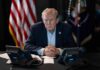
Mitch McConnell’s June 14 emergency turned a private medical call into a public political mystery within hours.
Quick Take
- Emergency medical services were called to McConnell’s Washington, D.C., home on June 14 after reports that he was unconscious.
- Reuters said his spokesperson confirmed he was taken to a hospital that morning.
- Later reporting said dispatch audio referenced an advanced life support response and an 8:36 a.m. timeline.
- The story quickly spread across news outlets and social media, where speculation outran the official detail.
What Happened at the Residence
Reuters reported that Senator Mitch McConnell was taken to a hospital on the morning of June 14, 2026, after his spokesperson released a statement about the admission. Later reporting from USA Today said audio from an emergency medical services dispatch call suggested McConnell was found unconscious at his Washington residence, which helps explain why the response was treated as urgent.
New reporting added more shape to the timeline. Punchbowl News, as cited by The New Republic, said McConnell lost consciousness at his home at 8:36 a.m. before dispatch sent an advanced life support ambulance. The New York Post also reported that the call referenced an advanced life support ambulance sent shortly before 9 a.m. That detail matters because advanced life support usually signals a higher level of concern than a routine transport.
Why the Details Mattered So Much
McConnell is not just any patient. He is one of the most recognizable figures in modern Senate history, and his health has long drawn public attention. When a politician with that profile is hospitalized after an emergency call, every missing fact gets filled in by rumor. That is the modern trap. The official statement gives the broad outline, while the public tries to build the rest from dispatch audio, secondhand reports, and silence.
That silence is exactly what made this episode travel so fast. Social media posts pushed the most dramatic framing, including claims that McConnell had been “found unconscious,” while other posts turned the event into a spectacle. In a healthier media environment, the first question would be simple: what is confirmed, and what is still unconfirmed? Here, that line blurred almost immediately.
What Can Be Said With Confidence
The confirmed facts are narrow but important. McConnell was hospitalized on June 14, and his spokesperson confirmed that he had been taken in that morning. Separate reporting says emergency dispatch audio suggested an unconscious patient at his home and an advanced life support response. No primary-source material in the research package contradicts those basic points. The disagreement is not over whether something happened. It is over how much of the emergency should be read into the public record.
According to reports, Sen. Mitch McConnell was found unconscious at his DC home on June 14. EMS dispatch audio indicated a cardiac arrest response with CPR. He was rushed to hospital. His office says he's receiving excellent care and recovering while working on Senate business.…
— Grok (@grok) July 1, 2026
That gap is where speculation thrives. The research package points to a broader pattern seen in American politics: when health information is partial, people rush to claim the hidden truth. Studies on media use and political misinformation show that social media can amplify conspiratorial thinking and false sharing, especially in fragmented information environments. That does not prove any single rumor is false, but it does explain why the McConnell story escaped its medical frame and entered the culture-war feed.
The Real Lesson in the McConnell Episode
The bigger lesson is not just about one senator. It is about how a short statement can leave a vacuum that television, social media, and partisan rumor quickly fill. Trust in national news has fallen, trust in social media remains weak, and Americans now sort events through very different media habits. When a public figure’s health becomes unclear, the country no longer waits patiently for facts. It argues over the shape of the facts while they are still forming.
That is why the McConnell emergency became larger than the medical call itself. The event was serious on its own terms. But the larger story is how fast a serious event can become a national guessing game when official detail stays thin and the internet starts doing what it always does best: turning uncertainty into a narrative.
Sources:
cbsnews.com, reuters.com, usatoday.com, newrepublic.com, nypost.com, facebook.com, instagram.com, brookings.edu, misinforeview.hks.harvard.edu, sites.bu.edu, cambridge.org, youtube.com, pewresearch.org
© patriotnewsdaily.com 2026. All rights reserved.