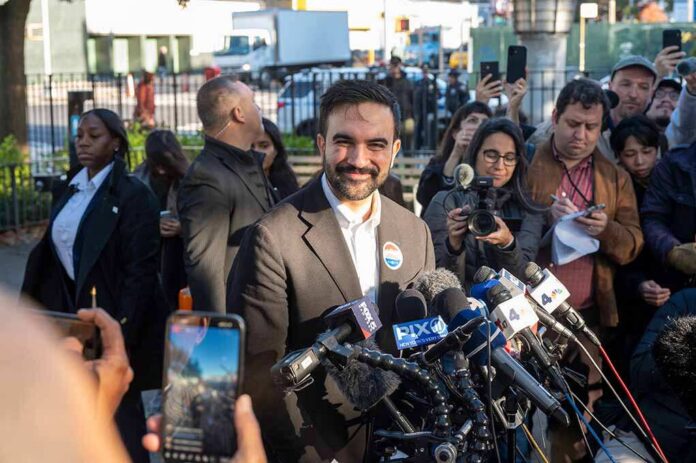
The promise was simple—30% off meat, produce, and staples for everyone—but the math never showed up.
Story Snapshot
- City Hall pledged a 30% monthly price cut on a core basket at five municipal groceries.
- The discount applies to all shoppers, not just low-income households.
- Officials earmarked $70 million for sites and build-outs; private firms would run stores.
- Critics say margins are 1%–3%, so taxpayers would cover the gap through subsidies.
What City Hall Promised, In Writing
New York City’s announcement set a clear headline number: a core basket, including all fresh produce and all meat, would be priced 30% below typical retail, locked in once a month with “no exceptions, no gimmicks”. The plan says the discount is universal, with no income checks at the register. Local television coverage underscored that the savings would be open to everyone and could mean about $90 per month for a typical shopper, roughly $1,000 a year.
The operating model blends public assets with private management. Reports describe rent-free or city-owned spaces and a capital budget of about $70 million for five stores, with private firms handling the day-to-day retail work. Officials limit the 30% intervention to a defined basket, while other products may sell at market rates. That design implies guardrails against storewide undercutting and leaves room to offset some losses with normal-margin items.
Where The Numbers Go Silent
The promise stops short of showing how the cash flows. The city’s materials do not reveal supplier contracts, gross-margin targets, labor budgets, shrink assumptions, or a five-year pro forma. The phrase “typical retail” lacks a published benchmark: no list of matched products, package sizes, grades, or audit methods. Without those details, the 30% claim rests on intent, not trackable unit economics or a verifiable price index.
That gap matters because groceries run on thin margins. Analysts and business press peg supermarket profits around the low single digits. A University of Chicago Booth economist argued that even removing profit would not yield 30% customer savings. If a store also loses money operationally, the taxpayer subsidy would have to exceed the headline discount to keep the lights on.
The Subsidy Question That Will Not Go Away
The central dispute is not whether the city can cut prices at checkout. It is who pays the difference. Commentators note grocery net margins near 1% to 3%, which cannot fund a 30% markdown on meat and produce without another payer. That payer is almost always the taxpayer through direct operating support or hidden transfers like free rent and public capital. The Atlantic put it plainly: selling much cheaper than private markets requires large public subsidies.
Trade and business reporting adds the competitive stakes. Independent grocers, bodegas, and immigrant-owned shops warn that a publicly backed rival could drain customers from thin-margin stores. Their groups are already mobilized and view the plan as an uneven playing field rather than fair competition. A universal discount intensifies that critique because higher-income shoppers also benefit, yet do not need help to buy chicken and lettuce.
What A Common-Sense Plan Would Show Before Opening Day
Taxpayers should not have to guess. A credible plan would publish a store-level pro forma for five years. It would show revenue by category, expected gross margins, labor schedules, utilities, security, shrink, logistics, and the exact public subsidy per dollar of discount. It would release the price index method, with matched bar codes, package sizes, weekly promotions, and an independent audit protocol that anyone can replicate. That is standard practice in serious public projects and honors the public’s role as the investor.
Mamdani refuses to 'walk through the math' when confronted over his plan for city-owned supermarkets | Thomas Stevenson, The Post Millennial
Socialist New York City Zohran Mamdani tried to explain his city-run grocery stores when he was confronted with the reality that grocery… https://t.co/MlyEMzFK4y
— Owen Gregorian (@OwenGregorian) November 20, 2026
City Hall has clear goals: lower grocery bills and improve access. Those goals are worthy. But goals do not balance ledgers. A monthly fixed 30% cut on perishable, high-shrink categories without a verified subsidy source risks the worst of both worlds—queues and shortages for shoppers, plus recurring bills for taxpayers. The conservative test is simple: if the model cannot stand on transparent math, it should not stand on your wallet.
Sources:
southshorepress.com, sacbee.com, fortune.com, nyc.gov, thegatewaypundit.com, minotdailynews.com
© patriotnewsdaily.com 2026. All rights reserved.