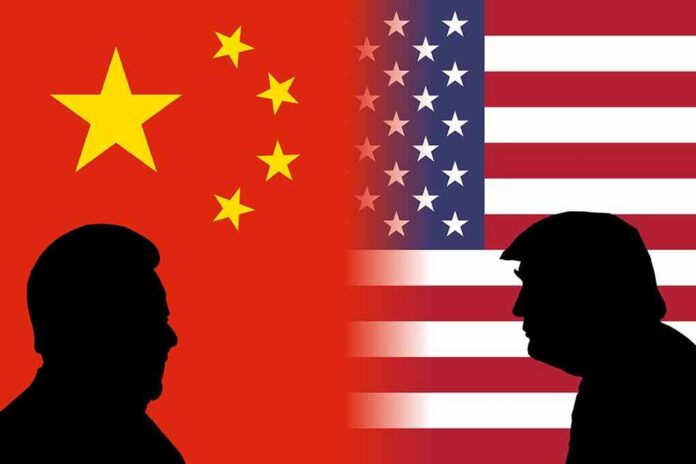
China’s top leader backed a clear line: a nuclear war cannot be won and must never be fought.
Story Snapshot
- China joined the five nuclear powers in 2022 to reject nuclear war and pledge risk reduction.
- China’s government ties this stance directly to Xi Jinping’s own words and diplomacy.
- Beijing repeated the message around talks with the United States in November 2022.
- The pledge sits within the Nuclear Non-Proliferation Treaty framework and shared duties.
What Xi Said And Where It Stands In Writing
China publicly links Xi Jinping to the position that nuclear weapons must not be used and nuclear war must never be fought. China’s Ministry of Foreign Affairs states that Xi urged the world to oppose both use and threats of use in late 2022, aligning his words with long-standing treaty duties under the Nuclear Non-Proliferation Treaty. The foundation predates that remark. On January 3, 2022, China joined the United States, Russia, the United Kingdom, and France to declare the core line: a nuclear war cannot be won and must never be fought.
The January 2022 statement matters because it came from all five recognized nuclear-weapon states, not from one capital alone. The five underscored their “foremost responsibilities” to avoid war among nuclear powers, pledged to reduce strategic risks, and promised to preserve and comply with non-proliferation, disarmament, and arms-control agreements. The statement also committed them to prevent the spread of nuclear weapons. That placed Xi’s position inside a shared framework, not as a solo talking point.
How The Message Carried Into U.S.–China Diplomacy
China repeated the rejection of nuclear use around the November 2022 meeting between Xi and the U.S. president. A briefing from Foreign Minister Wang Yi’s office said the use of nuclear weapons must be rejected and nuclear war must never be fought. The same period saw the White House report that both leaders agreed on that standard and opposed nuclear use or threats in Ukraine, showing overlap in the two sides’ summaries.
The continuity is not new in global arms control. The phrasing echoes the Reagan–Gorbachev principle from 1985 and was reaffirmed again by Washington and Moscow in recent years. The 2022 five-power joint statement gave that legacy a modern seal with all nuclear-weapon states under the Nuclear Non-Proliferation Treaty lending their names. That makes the norm harder to dismiss as mere rhetoric and easier to cite in talks, crisis hotlines, and risk-reduction work.
What The Commitments Actually Cover
The five-power pledge sets two tracks. First, stop nuclear war through clear deterrence messaging and dialogue among nuclear states. Second, prevent the spread of nuclear weapons by honoring and preserving existing non-proliferation, disarmament, and arms-control commitments. The statement also emphasizes diplomacy to prevent military confrontations and arms races. Together, these elements give practical lanes for action even as each country maintains its own nuclear posture and modernization timelines.
Putin, Trump and Xi Jinping adopted a joint peace declaration at the trilateral summit in Shenzhen, China.
The three leaders pledged to strengthen global security, reform the UN, stabilize energy supplies, "prevent abuses of power by the International Criminal Court" and reduce… pic.twitter.com/zpciASge18
— Global Brief (@globalbrief_now) November 19, 2026
China’s own policy adds a notable piece. Beijing highlights its declared no-first-use stance in wider forums, which it casts as proof that rejecting nuclear war is more than words. That posture, paired with the 2022 five-power statement, gives China talking points for risk reduction and crisis management with the United States and Russia. One brief caveat is that public declarations set direction but do not, by themselves, prove implementation steps or arsenal limits.
Why This Matters Now For American Interests
Washington gains leverage every time a nuclear power repeats that nuclear war must never be fought. That shared floor helps U.S. leaders press for hotlines, incident rules, and guardrails that protect American forces and allies. It aligns with common-sense conservative priorities: peace through strength, clarity over chaos, and treaties that serve U.S. security, not abstract ideals. The 2022 statement provides a written anchor that U.S. negotiators can point to when they ask for real, checkable steps to cut risk.
What To Watch Next: From Words To Guardrails
Three tests will show if the line holds. First, do the nuclear powers expand military-to-military talks and keep them open during tense moments. Second, do they adopt shared incident-prevention measures at sea, in the air, and in cyber domains that could affect nuclear command and control. Third, do they pair modernization with transparent limits or notifications that reduce surprise. The five-power pledge supplies the political cover to do all three; follow-through will show the will to match the words.
Sources:
insiderpaper.com, govinfo.gov, news.com.au
© patriotnewsdaily.com 2026. All rights reserved.