
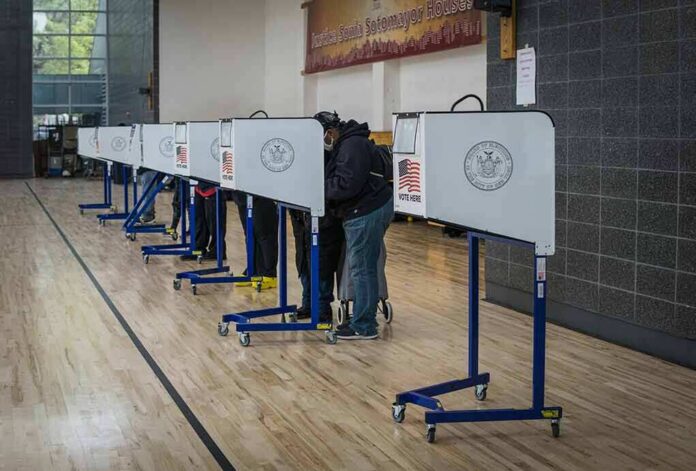
One hard number explains 2026: tens of millions of Trump’s 2024 voters stayed home, and it flipped Congress.
Story Snapshot
- A J.L. Partners Election Day survey said 35% of Trump’s 2024 voters skipped 2026.
- Only 8% of those voters allegedly switched to Democrats, pointing to turnout, not persuasion.
- The firm’s breakdown tied most of Democrats’ national swing to Republican no-shows.
- Independent analysts still flagged an anti-Trump vote among participants as a force.
The claim: absentees sank Republicans, not defectors
J.L. Partners reported a blunt split: 35% of Trump’s 2024 voters did not vote in 2026, while 8% crossed over to Democrats. The firm framed the national swing as mostly a turnout gap, not a persuasion wave, assigning roughly two-thirds of the Democratic surge to Republican drop-off rather than switching. Founding director James Johnson linked that pattern to lost House and Senate control, saying the math alone would have cost Republicans Congress even with zero switchers.
Secondary reports said the missing voters came from three Trump-leaning blocs: non-college voters, rural voters, and retirees. That profile fits classic midterm drop-off behavior. These groups vote heavily in presidential years but weaken in midterms when logistics, energy, and perceived stakes fall. The practical read for campaigns is concrete: schedule early voting rides, build absentee habits, and put community leaders on turnout duty where social trust beats yard signs.
Method caveats: what we know and what we do not
The topline rests on a 1,000-person Election Day survey, checked against more than 30,000 campaign interviews, but the public does not have the full report, weighting, or questionnaire. The outlets did not say whether J.L. Partners validated 2024 votes through state files or used self-reports, which can inflate “I voted for X” claims after the fact. The five-versus-ten point swing split also lacks a shown formula, so readers should treat the exact shares as estimates, not a measured audit trail.
That said, the big idea passes a smell test with history. Midterms have lower turnout than presidential years. The party that mobilizes its casual voters tends to win close maps. Prior research found turnout gaps often decide House control when persuasion is modest and partisan ties are strong. The 2026 mix likely featured both effects: fewer Republican-aligned voters showing up and a smaller set shifting sides.
Counter-angles: backlash, switching, and participation gaps
Other analysts stressed a live anti-Trump vote among those who did participate. Networks reported that voters who disapproved of Trump backed Democrats by lopsided margins in Senate races and the national House vote, showing active backlash where it mattered most. Data scientist Lenny Bronner estimated that about one-fifth of Democratic gains came from Republicans switching, with most gains still from turnout gaps. That blend reinforces the core: turnout led, switching followed.
Yahoo’s synthesis pointed to a plain participation delta, estimating about 61 million Harris-aligned voters and 57 million Trump-aligned voters cast ballots in 2026, which frames the loss as a coalition turnout imbalance more than mass conversion. For conservatives, the lesson is not mystical. If four million on your side miss a midterm, you spot the other team a wave. The fix is logistics, message focus, and repeated contact that turns likely voters into actual voters.
Strategic translation: from shock to a turnout machine
Campaigns should treat the dropout profile like a home address list. Rural, non-college, and retiree voters need friction removed. Mail voting habits, church-based reminders, simple ride-share trees, and early-ballot chases close those cracks. Messaging should stay grounded: inflation, safety, energy, and schools. Candidates should be visible in small towns and union halls, not just on national shows. Persuasion still matters, but closing the participation gap is cheaper, cleaner, and faster to scale.
One caution for planners: do not let a turnout story become an excuse to dodge candidate quality or issue fit. Voters who dislike a standard-bearer will show it, and 2026 showed that too. Build a ballot that earns respect, then move heaven and earth to get your people to the polls. If J.L. Partners is even directionally right, Republicans left winnable seats on the table because their own voters never walked in the door.
Sources:
townhall.com, yahoo.com, politicalwire.com, cleveland.com, nation.com.pk, nbcnews.com
© patriotnewsdaily.com 2026. All rights reserved.