Experts told a coroner that a Dover grandmother’s sudden death came from internal bleeding, not the concrete fall that everyone saw.
Story Snapshot
- Christine Faunch fell from a stretcher while being moved by paramedics in Kent.
- She died hours later at William Harvey Hospital from a ruptured spleen, the inquest heard.
- Medical experts told the court the fall was most likely not the direct cause.
- The ambulance service apologized to the family for the distress around the incident.
What Happened During The Transfer
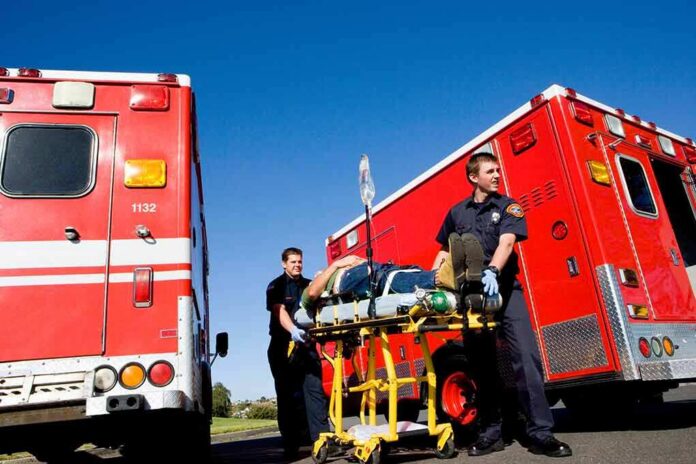
Paramedics moved Christine Faunch on a stretcher when the transfer went wrong. She fell and struck the concrete, drawing gasps from witnesses, according to reporting from the inquest. Staff and medics responded at once. She was taken for scans and treatment at William Harvey Hospital in Ashford. The sequence felt simple from the outside: a fall, then a death. Families often link those moments. Coroners must test that link with medical detail, not headlines, and that is where this case turned.
Doctors found major internal bleeding and a ruptured spleen. The coroner heard expert evidence that pointed to the spleen injury as the fatal mechanism. Those experts told the court that the fall from the stretcher was most likely not the direct cause of the rupture. That conclusion does not erase the shock of the drop or the pain it caused. It draws a line between what looked like the cause and what the body showed as the cause.
What The Inquest Actually Decides
Coroners separate three things: what physically caused the death, what may have contributed, and how the death should be classified. That mix can be confusing. A fall can be a contributing event but not the lethal blow. In this case, the inquest evidence tied death to the ruptured spleen and catastrophic bleeding, not to head trauma from the concrete impact. This difference guides recommendations, training fixes, and any legal risk that might follow.
Public reporting often compresses all of that into one line. “Dropped from stretcher, died hours later” sounds open and shut. Prior inquests show that the medical chain can be more complex. One matter in New Zealand found a death directly tied to a stretcher fall and head injury. Another case in Massachusetts ended in a wrongful death verdict after a head-first drop. Other cases have been dismissed or narrowed when evidence did not prove direct causation. Each turns on facts, scans, timelines, and expert judgment.
Accountability, Apology, And The Line Between Blame And Cause
The ambulance service apologized to the family for the distress and the transfer failure. That apology matters. It respects the family’s loss and the basic expectation that a stretcher must be safe. It does not, by itself, answer the medical cause. Policy should treat both lanes: human dignity and hard proof. Common sense says fix the preventable parts first. That means training on transfers, gear checks, and clear rules for moving patients, especially when spaces are tight or surfaces are uneven.
NEWS: Ambulance service bosses have apologised to the grieving family of a gran who fell off a stretcher and hit her head hours before her death #kmfmnewshttps://t.co/nGsN8MRjTP
— kmfm news (@kmfmnews) August 9, 2026
Families deserve plain answers, not hedged jargon. This case shows how to give them. Say what failed in the transfer. Say what the scans and surgeons found. Say whether the failure likely caused the death or only added trauma. Then publish changes that reduce repeat risk. Inquests exist for that purpose. They are not theater. They are a safety ledger. When agencies face up to error, keep records public, and follow through on fixes, trust grows even after tragedy.
Sources:
mirror.co.uk, nzherald.co.nz, ems1.com, foxbusiness.com
© patriotnewsdaily.com 2026. All rights reserved.