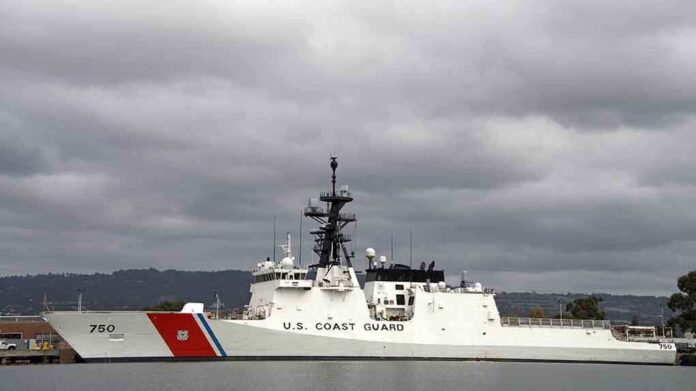
The U.S. Coast Guard’s strategic deployment in the Bering Sea is a critical step in asserting American sovereignty and protecting vital resources from foreign encroachment.
At a Glance
- USCGC Munro’s 121-day deployment in the Bering Sea focused on maritime security.
- Heightened U.S.-Russia tensions underscore the strategic importance of the region.
- The Bering Sea is crucial for a $6 billion Alaskan fishery.
- Munro’s operations included 32 boardings and key SAR missions.
Defending U.S. Interests in the Bering Sea
The Bering Sea, a critical maritime region, serves as a gateway between the United States and Russia’s Far East. This strategically sensitive area is a hub for international shipping and military navigation, making it a focal point for U.S. maritime security. The recent deployment of the USCGC Munro, a National Security Cutter, underscores the United States’ commitment to maintaining a visible maritime presence in this vital region.
The Bering Sea supports a $6 billion Alaskan fishery, crucial to U.S. economic and food security interests. The harsh weather and vast distances in the area complicate enforcement and search and rescue operations, adding to the strategic complexity. The maritime boundary between the U.S. and Russia often becomes a flashpoint for jurisdictional and resource disputes, necessitating a robust American presence to deter illegal activities and assert sovereignty.
USCGC Munro was deployed to provide a U.S. maritime presence in the Bering Sea that separates Alaska and Russia's Far East. https://t.co/JX1pjy81SC
— Newsweek (@Newsweek) July 24, 2025
Munro’s Mission and Achievements
The USCGC Munro’s 121-day deployment in 2025 focused on enforcing fisheries regulations, deterring illegal activities, and supporting search and rescue readiness. During its mission, Munro completed 32 boardings of commercial fishing vessels, hosted a NOAA law enforcement officer, and responded to multiple search and rescue cases. These efforts highlight the cutter’s role in promoting maritime governance and enforcing domestic fishery regulations.
Munro’s crew conducted over 100 flight evolutions with three aircraft and qualified eight pilots for search and rescue missions. This deployment exemplified interagency coordination and readiness, further emphasizing the importance of maintaining a persistent U.S. presence in the Bering Sea.
Strategic Implications and Stakeholders
The short-term impacts of Munro’s deployment include enhanced enforcement of fisheries laws, deterrence of illegal activities, and improved search and rescue readiness in the Bering Sea. Long-term, this operation reinforces U.S. sovereignty, supports sustainable fisheries, and maintains the strategic balance with Russia in the Arctic region.
The deployment impacts various stakeholders, including the Alaskan fishing industry, indigenous and coastal communities, and international actors such as Russian authorities. Protecting the $6 billion fishery ensures long-term resource sustainability and economic stability for Alaska. Additionally, robust search and rescue capabilities enhance safety for mariners and coastal residents.
The Broader Picture and Future Considerations
Munro’s deployment sets a precedent for interagency and international cooperation in maritime enforcement. It highlights the need for continued investment in high-endurance cutters and Arctic-capable assets to meet rising challenges in the region. Maritime security scholars emphasize the importance of U.S. Coast Guard deployments in upholding international law and deterring illegal fishing activities.
As the Arctic region becomes a theater of strategic competition, the United States must remain vigilant in asserting its interests while balancing cooperation and competition with Russia. Continued investment in infrastructure and ice-capable vessels will be crucial in meeting the challenges of this dynamic region.
Sources:
USCG official press release, July 22, 2025
USCG Pacific Area, Munro history and characteristics
Library of Congress, Munro operational history
Juneau Empire, March 28, 2025, Munro patrol coverage