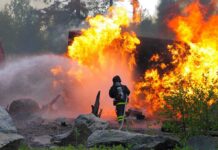
A hazardous blaze involving a semi-truck loaded with Teslas unleashed chaos on a major California freeway, exposing the real risks of electric vehicle technology and raising new questions about public safety, environmental hazards, and government oversight.
Story Snapshot
- A semi-truck hauling eight Teslas caught fire on the 5 Freeway in Sylmar, shutting down all southbound lanes for hours amid hazardous smoke and runoff.
- The fire’s intensity was fueled by lithium-ion batteries, complicating firefighting and sparking a prolonged hazmat response.
- No injuries were reported, but the incident highlighted the unique dangers of transporting large numbers of electric vehicles through densely populated areas.
- Ongoing cleanup and investigation are prompting calls for stricter safety protocols and oversight in EV transit.
Lithium-Ion Blaze Paralyzes Critical Freeway Corridor
On Saturday, August 16, 2025, a semi-truck carrying eight Tesla vehicles ignited on the southbound 5 Freeway near Balboa Boulevard in Sylmar, California. The resulting fire forced authorities to close all southbound lanes and some northbound lanes, diverting thousands of drivers and crippling one of the state’s vital transportation arteries. First responders faced an uphill battle as toxic smoke and runoff from burning lithium-ion batteries complicated the firefighting operation, requiring a specialized hazardous materials response. The fire was declared out by the Los Angeles Fire Department at 9:30 p.m., but truck lanes remained closed into the following morning for cleanup and investigation.
Officials confirmed that no injuries occurred, and the truck driver escaped unharmed. However, the environmental and logistical fallout was immediate and severe: hazardous smoke threatened nearby residents and commuters, while the closure of a major freeway on a busy weekend evening intensified traffic gridlock across the region. Two of the eight Teslas reportedly survived the fire and were slated for removal, but the overall destruction underscored vulnerabilities in the transport of electric vehicles. The cause of the fire remains under investigation, with no official determination released.
Risks of Electric Vehicle Transport and Public Safety Concerns
The Sylmar incident is only the latest in a series of EV-related transport emergencies that have tested the limits of public safety infrastructure. Lithium-ion battery fires present unique challenges: they produce thick, toxic smoke, can reignite unexpectedly due to thermal runaway, and often require far more resources and time to extinguish than conventional vehicle fires. Fire safety experts and transportation analysts have repeatedly warned that the rapid expansion of electric vehicle fleets—especially in transit through urban corridors—demands updated safety protocols, enhanced first responder training, and possibly new regulations for hazardous materials transport. Commuters, logistics companies, and emergency personnel all face heightened risk when these high-tech vehicles are moved in bulk.
Previous incidents have led to advisories from agencies such as the National Transportation Safety Board, highlighting the need for specialized equipment and procedures. The Sylmar fire also raises broader questions about government oversight: Are current regulations sufficient to protect the public from the hazards posed by mass EV transport? And who bears responsibility for the costs—both economic and environmental—when such disasters strike?
Economic Fallout and Industry Implications
The immediate impact of the fire was felt by thousands of commuters delayed for hours and by businesses dependent on the 5 Freeway for just-in-time delivery. The destruction of several high-value Teslas adds to the economic toll, while the spectacle of a major EV fire has potential to damage consumer confidence in electric vehicles. For Tesla and the broader industry, this event is a reputational setback that could fuel calls for mandatory safety improvements, tighter oversight, or even restrictions on how and when large numbers of EVs can be transported through populated areas. Emergency responders, meanwhile, face ongoing exposure to hazardous byproducts, raising concerns about long-term health risks and the adequacy of current protective measures.
With cleanup and hazardous materials containment still underway as of Sunday morning, the long-term policy implications are just beginning to emerge. Some experts advocate for better packaging and monitoring of EV shipments, while others point to the need for public education on responding to lithium-ion fires. What remains clear is that the push for electrification, when not matched by robust safety standards and government accountability, risks further endangering communities and straining emergency resources. As the investigation continues, conservative observers are likely to demand answers and action to prevent similar incidents—and to ensure that “green” technology does not come at the expense of public safety, fiscal responsibility, or common sense.
Sources:
Semi-truck carrying Tesla vehicles catches fire, shuts down 5 Freeway in California | KYMA
Car carrier truck loaded with Teslas causes hazmat fire, 5 Freeway, Sylmar | ABC7
Sylmar 5 Freeway semi-truck electric vehicle fire | CBS Los Angeles