Florida’s governor race sits on a knife’s edge, with Byron Donalds holding a slim but real polling lead as early-vote math sparks last-minute nerves.
At a Glance
- Most late October polls showed Donalds narrowly ahead of David Jolly.
- A polling average put Donalds near 48.5% to Jolly’s 44.8% through Oct. 20.
- Republicans held a small edge in early and mail ballots by Oct. 30.
- Democratic and Republican estimates warned of a large early-vote gap to overcome.
What The Polls Actually Showed
Public polling near the finish showed a race that was close but leaning toward Donalds. A New York Times–Siena survey fielded Oct. 19–25 put Donalds at 48% and Jolly at 44%. Another late poll cited in coverage had Donalds ahead 49% to 47%. A rolling average compiled by Election.org across seven likely-voter polls from Sept. 28 to Oct. 20 showed Donalds at 48.5% and Jolly at 44.8%. These are measurable advantages, not blowouts. Several margins sat near typical error bands, which kept both campaigns engaged.
The poll picture carried a simple lesson. Donalds led, but the cushion was thin. For readers who like scoreboards, that means every point of turnout and each swing among independents mattered more than message flair. Claims that Jolly surged were not the core story in the cited data; the story was a steady, small Donalds edge with a tight range of outcomes. That fits Florida’s recent history: competitive statewide races hinge on modest shifts among late deciders and reliable turnout machines.
Early Voting And The Math That Frayed Nerves
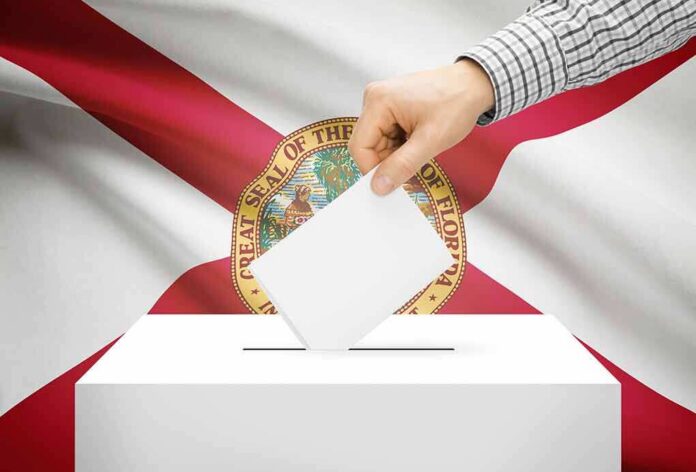
Early and mail-ballot composition fueled most of the anxiety. By Oct. 30, Republicans accounted for about 40% of early and mail votes, Democrats 38%, and independents 21% according to local reporting. That share gave Republicans a lead, but a smaller one than their double-digit registration edge, which raised alarm in some coverage. Axios reported internal estimates that Donalds could enter Election Day down as many as 500,000 votes, implying he might need to win in-person votes at roughly two to one to catch up.
Those estimates traveled fast and grew louder in secondary write-ups, which cast the gap as a “bombshell” and highlighted the steep Election Day target. The number is stark, and it explains the “white-knuckled” description applied to Florida Republicans. Yet early-vote numbers identify who voted, not how they voted. Party labels help, but do not convert one-for-one into candidate totals. Conservative common sense says: bank what you can early, then flood precincts on Tuesday. That is exactly what Donalds’ team aimed to do.
Turnout Geography And The Byron Donalds Coalition
Turnout patterns mattered as much as totals. Reporting that cited University of Florida political scientist Michael McDonald pointed to softer Republican participation in parts of the Panhandle and rural North Florida. Those areas reportedly lagged by a few points more than places Donalds carried in the primary. If correct, that pocket weakness suggested he needed stronger Election Day lifts in swing suburbs and high-growth counties to offset it. That is a tall but clear task list: energize base voters where lagging and squeeze more from independents in the Interstate 4 corridor.
Donalds had the tools to try. His campaign and allied committees reportedly raised more than $148 million and enjoyed about a $33 million cash advantage late in the race. Money does not vote, but it does fuel field staff, voter contact, and saturation ads in the final 72 hours. Research often links spending with higher turnout, but the effect size depends on targeting and message fit. The open question for both sides was whether their dollars were buying actual ballots, not just airtime.
What To Watch On Election Day
Three checkpoints decide whether the “too close” label holds. First, midday turnout rates in Miami-Dade, Broward, Hillsborough, and Orange tell us whether Democrats matched their early pace or front-loaded their vote. Second, Republican margins in the Panhandle, in Southwest Florida, and in exurbs like Pasco show whether base slippage persisted or snapped back. Third, independent-heavy precincts in Tampa and Orlando suburbs indicate if Jolly’s closing argument stuck with late deciders reported in some coverage. Add those together, and the scoreboard will move fast.
boris sanchez: “president trump is taking his campaign tour back to florida shortly, as new polling finds the fight to be that state's next governor is nearly tied. new york times siena poll shows democrat david jolly trailing trump ally byron donalds by four points, barely… pic.twitter.com/MxuX6YhEum
— corgi (@wordsdematthew) October 30, 2026
One final frame helps keep this straight. Most polls pointed to a narrow Donalds edge into the last weekend. Early-vote shares showed a smaller-than-expected Republican cushion, which made Republicans uneasy. Internal estimates flagged the possibility of a large early deficit, which raised the bar for Tuesday turnout. All three can be true at once. The winner is the side that converts message and money into bodies at the polls when it counts.
Sources:
axios.com, rawstory.com, en.cibercuba.com, alligator.org, orlandosentinel.com, desmoinesregister.com, election.org
© patriotnewsdaily.com 2026. All rights reserved.