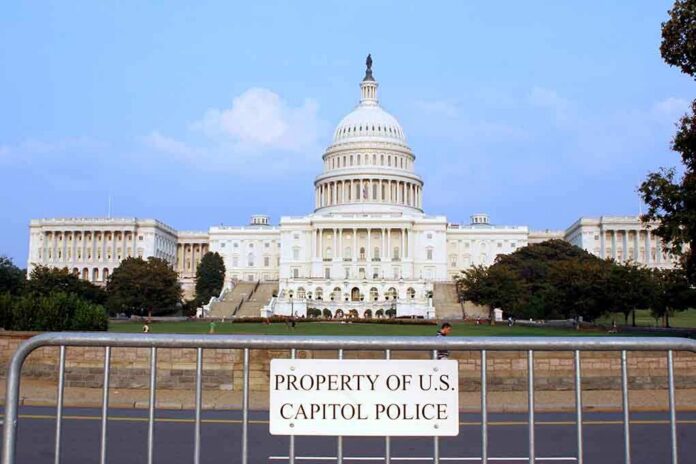
The House’s first successful vote to rein in Iran war powers puts Congress back in a fight the Constitution was designed to settle, not leave to one man alone.
Quick Take
- The House passed a war powers resolution on Iran by a 215 to 208 vote.
- At least four Republicans joined Democrats in support.
- The measure would require congressional authorization for further force against Iran.
- The administration said a ceasefire had already ended the hostilities.
House Backs Limits on Further Strikes
The House passed a war powers resolution Wednesday that would block President Trump from ordering more strikes on Iran without congressional authorization.[3] CBS News reported that the vote was 215 to 208 and marked the first time the House successfully approved this type of measure in the current conflict.[3] The resolution is framed as a direct check on executive war powers, which is exactly the kind of constitutional boundary many voters expect Congress to defend when military action is on the table.
According to Congresswoman Shontel Brown’s office, the resolution directs the president to terminate the use of force against Iran unless Congress explicitly authorizes it.[1] Brown’s press release also said House Democrats had already forced three votes to end the war in Iran and that the prior vote ended in a 212 to 212 tie, showing that the issue has been building for months rather than appearing out of nowhere.[1] That history matters because it shows a sustained effort to force accountability on a war that should not proceed on autopilot.
Republican Crossovers Show the Pressure
The vote was not purely partisan, even though the political climate around it is sharply divided.[3] CBS News reported that at least four Republicans crossed over to support Democrats, and the Associated Press summary likewise noted that the measure passed 215 to 208 with four Republicans backing it.[2][3] For conservatives who want limited government and a serious Congress, those crossovers matter because they show that the constitutional question is bigger than party loyalty and bigger than campaign messaging.
At the same time, the same reports make clear that the House vote does not immediately halt military activity against Iran.[2] CBS News described the resolution as a “symbolic if not legal step” and said it would not immediately stop the war.[2] That detail gives opponents room to downplay the vote, but it also explains why the struggle now shifts to the Senate, where lawmakers must decide whether they will match the House or let the matter stall again.[2]
Ceasefire Claim Complicates the Debate
The administration’s defense rests on the argument that a ceasefire has already been declared and that the hostilities have ceased.[2] That claim weakens the case for urgent congressional action if it is accepted at face value, because it suggests the conflict may already have moved out of an active combat phase.[2] But the House vote shows many lawmakers are not willing to let the executive branch define the end of the conflict on its own terms, especially when further strikes could be ordered later without a fresh vote.
President Trump just went OFF on the House:
“Yesterday, in a meaningless vote, the House voted, 4 bad Republicans and all of the Democrats, to limit my War Powers, right in the middle of my final negotiations to end the War with the Islamic Republic of Iran. Who would do such pic.twitter.com/yd2qC04V9c
— LeRoy Clary (@LeRoyClary3hv7) June 4, 2026
Brown’s office said war powers resolutions are privileged in the House, meaning the issue can keep returning to the floor until Congress settles it one way or another.[1] That procedural reality is important for readers who are tired of endless foreign entanglements and executive overreach, because it shows the legislative branch still has tools to push back.[1] Whether the Senate follows through will determine whether this becomes a real constitutional check or just another Washington warning shot that fades after the headlines move on.
Sources:
[1] Web – House Votes for First Time To Halt Iran War
[2] Web – Brown Introduces War Powers Resolution to End Trump’s Disastrous …
[3] YouTube – House votes to rein in Trump’s military action against Iran
© patriotnewsdaily.com 2026. All rights reserved.