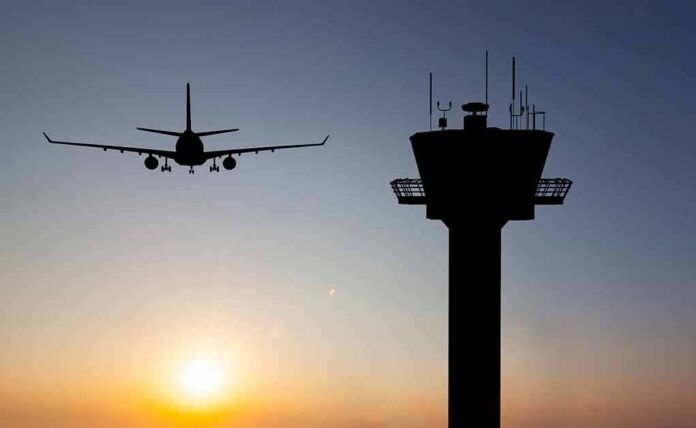
A nationwide ground stop grounded commercial flights across America for nearly five hours, and the man in charge of fixing it wants $50 billion to make sure it never happens again.
Quick Take
- Transportation Secretary Sean Duffy asked Congress for $50 billion after a November 13 ground stop tied to overloaded telecom routers and radar systems.
- Officials said old analog equipment failed while newer digital switches kept working, pointing to a clear upgrade target.
- Congress already approved $12.5 billion for air traffic control fixes before Duffy raised his ask from $30 billion to $50 billion.
- Some lawmakers want proof the FAA spent its current money well before handing over billions more.
What Actually Shut Down The Nation’s Skies
The Department of Transportation said the ground stop started after telecommunications outages made radar and air traffic control communications unstable. Duffy described it plainly: “Our switches, our routers actually got overloaded with data.” The system began spitting out bad information, so controllers shut it down rather than risk a mistake. No one was hurt. Every plane landed safely. But the country watched its air travel system halt in real time.
The outage rippled across the country for close to five hours, canceling and delaying flights nationwide before the Federal Aviation Administration lifted the stoppage. That scale of disruption, without a single crash or injury, is itself the strongest argument Duffy has. A system that can freeze an entire nation’s air traffic over router overload is a system worth examining closely.
Old Wires Versus New Switches
Duffy’s team drew a sharp line between what failed and what held up. The briefing noted the agency still runs TDM telecom, old analog technology, while newer IP-based switches installed under this administration kept functioning. That distinction gives the $50 billion request a specific target: replace the aging analog backbone, not just throw money at the whole system blindly. Transportation Secretary nominee pick Mullin added that the fix “has to be a complete overhaul,” not a patchwork repair.
Fox Business reported the money would go toward new hardware, software, telecommunications equipment, and aging control towers. That’s a more concrete shopping list than a vague modernization slogan. Still, concrete categories are not the same as a detailed budget. Nobody has published a line-item plan showing exactly how $50 billion splits between towers, routers, and software contracts.
The Math Behind The Bigger Number
Congress had already approved $12.5 billion for air traffic control upgrades through the One Big Beautiful Bill Act, covering more than 10,000 separate projects. Duffy had previously asked for $30 billion on top of that. After the ground stop, he raised the figure to $50 billion. That jump of $20 billion, arriving right after a dramatic national outage, is the detail critics keep circling back to.
Who’s Pushing Back, And Why It Matters
Senator Jerry Moran, the Republican who leads the Senate’s aviation subcommittee, said he backs more funding but first wants to know how the FAA spent money Congress already gave it. That’s a fair, conservative instinct: demand accountability before writing a bigger check. Some Democratic lawmakers raised similar questions about whether existing funds were used efficiently before new billions get approved.
National security analyst Juliette Kayyem criticized how Duffy presented the request, pointing to other large federal spending commitments as context. That’s a political jab more than a technical rebuttal, and it doesn’t challenge the underlying claim that the FAA’s equipment is old. Still, it reflects a real tension: asking for emergency money right after a crisis always invites suspicion, deserved or not.
White House Strikes Back After Hochul Demands Sean Duffy Be Fired
After Friday’s nationwide FAA ground stop (triggered by a contractor router issue during a copper-to-fiber upgrade), New York Gov. Kathy Hochul demanded Transportation Secretary Sean Duffy resign or be fired by… https://t.co/Dt4g03hkWm pic.twitter.com/VcDbgcc1JH
— Patricia 🇺🇸 (@1109Patricia) November 15, 2026
Government Accountability Office reviews back up the bigger picture here, independent of this administration. After a 2023 airspace shutdown, the FAA assessed 138 air traffic control systems and found 51 unsustainable, with another 54 potentially unsustainable. That’s not a talking point invented this month. It’s the agency’s own risk assessment, built years before this latest outage, showing the obsolescence problem runs deep and predates any single administration’s funding request.
The Real Question Facing Congress
Nobody seriously disputes that parts of America’s air traffic system are old and fragile. The GAO has said so for years, and this outage proved it in dramatic fashion. The real fight is over scale, oversight, and sequencing: does $50 billion buy a fully modernized system, or does it repeat a pattern GAO has flagged before, where big technology programs run late, over budget, and short of promised results.
Conservatives should welcome real infrastructure investment, especially for something as basic as keeping planes safely in the sky. But welcoming investment and demanding a transparent, audited spending plan are not contradictory positions. Congress can fund modernization and still require Duffy’s department to show its work, line by line, before cutting a check five times bigger than what lawmakers already approved this year.
Sources:
thehill.com, abcnews.com, bloomberg.com
© patriotnewsdaily.com 2026. All rights reserved.