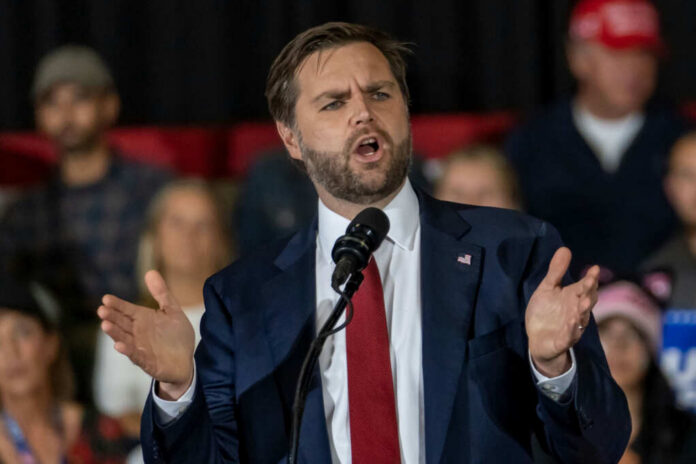
President Trump shut the door on an Iran deal and reassigned Vice President JD Vance to chase domestic corruption, claiming America already holds the leverage.
Story Snapshot
- Trump said the United States does not need an Iran agreement and halted Vance’s talks.
- Vance was told to focus fully on alleged corruption in Democrat-led states and cities.
- Trump cited control over Iran’s money and the Strait as leverage for pressure, not compromise.
- Vance had recently said progress toward a negotiated settlement was possible.
Trump Ends the Iran Track and Redirects Vance
President Trump announced he would not pursue an Iran agreement and ordered Vice President JD Vance to focus on domestic corruption instead. He posted that Vance should put his full attention on crime and corruption in Democrat-run jurisdictions. He also wrote that the United States does not need a deal with Iran and that pressure is enough. Reports said the decision halted Vance’s involvement in talks and matched a wider push to keep strong economic and maritime pressure on Tehran.
Trump framed the move as a use of leverage, not a retreat from goals. He pointed to United States control over frozen Iranian assets and the shipping chokepoint as reasons a deal is unnecessary. Coverage described a strategy to maintain a naval blockade and sanctions, rather than trade relief for limits and inspections. That posture makes pressure the policy, not a bridge to compromise. It also places Vance on a new mission at home, with rhetoric that names specific political opponents.
Vance’s Prior Diplomacy and the Sudden Shift
Vance had told reporters days earlier that the United States and Iran had made progress toward a settlement. He said there had been good conversations and that a firm, verifiable commitment on Iran’s nuclear program was essential. Those remarks suggested a path for talks still existed. Trump’s directive cut that path short and reassigned his vice president to a domestic push. The change created a visible break between Vance’s optimism on talks and Trump’s no-deal stance.
Timing added political heat. Vance had tied Republican midterm losses to the Iran war. Trump acknowledged the war’s political cost but defended the decision to confront Iran. The administration’s shift from Vance’s diplomacy to a corruption drive invites a simple read: end foreign bargaining, press at sea and in markets, and pivot at home to expose alleged fraud and waste. That sequence tracks with a hard-power-first approach paired with a law-and-order message.
What “No Deal” Means for Strategy and Markets
Choosing pressure over a written agreement means the White House trusts sanctions, asset controls, and maritime interdiction to box in Tehran. That setup can bite hard in the short term. It can also tempt Iran to probe for gaps at sea and in sanctions networks. Energy prices often react to choke-point risk, even without shots fired. A sustained naval posture is expensive, but it signals resolve. The approach aligns with conservative instincts: keep leverage, avoid cash-for-promises swaps, and demand results first.
He learned nothing from the midterms.
Trump Says He’s Pulling Vance Off Iran Talks to Focus on Fraud Campaign https://t.co/aB1PnF7fmD via @NYTimes
— Anthony G. Bridges (@anthonygbridges) November 12, 2026
Diplomacy supporters argue that only a deal brings inspectors, timelines, and clear nuclear limits. Trump’s team argues that time and economics can do the same job by starving the program and deterring escalation. The record so far shows a firm White House direction but does not include a public technical plan for verification in place of a deal. That is not unusual in early strategy calls, but it leaves outside observers focused on outcomes on the water and in Iran’s economy.
Vance’s New Domestic Mission and Its Claims
Trump said rooting out big-city corruption could recover vast sums and help balance the budget. He linked the push to alleged schemes in Democrat-led areas and cast it as a moral and fiscal fight. The comments did not present a scored program or named cases tied to a dollar figure. They did, however, set a clear political target list and a priority for the vice president’s time. The Axios and regional reports framed the assignment as a formal redirection of Vance’s portfolio.
Conservatives will hear a familiar logic: stop sending leverage overseas, fix the mess at home, and put prosecutors and auditors to work. That view prizes accountability and fiscal discipline. It also expects results that can be measured in indictments, recovered funds, and cleaner books. The test now is execution. If Vance builds a structure with the Department of Justice and inspectors general, the effort can claim seriousness. If not, opponents will call it campaign rhetoric in search of headlines.
The Political Bet Behind the Policy
The White House bet that voters prefer strength without concessions abroad and a crackdown on waste at home. That is a clean, forceful message. It contrasts with Vance’s recent talk of progress in negotiations and suggests the president values pressure over process. If the Iran stance holds shipping steady and keeps costs down, it will look prudent. If energy spikes or fighting grows, calls to revisit a deal may return. The domestic drive will face the same scoreboard pressure: show receipts, or refocus.
Sources:
thenewstribune.com, nytimes.com, cleveland.com, newsobserver.com, axios.com, washingtonpost.com, telegraph.co.uk
© patriotnewsdaily.com 2026. All rights reserved.