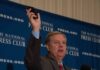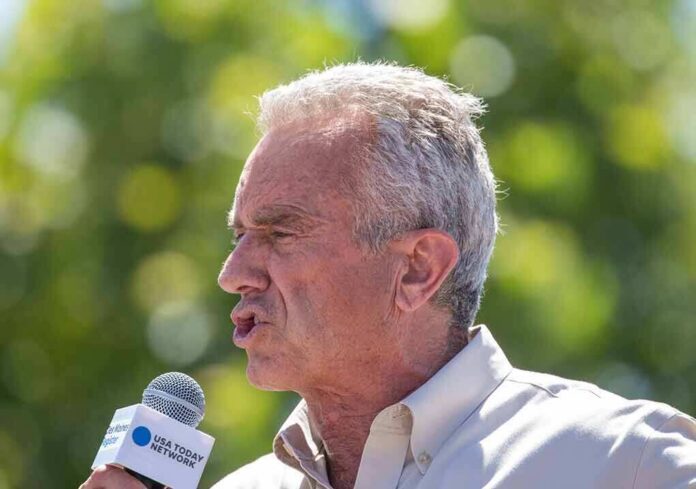
Robert F. Kennedy Jr., the sitting Secretary of Health and Human Services, told a Michigan campaign crowd that 500 million Arabs produce no science, no Nobel Prizes, and no literature — only “hatred” and “war.”
Quick Take
- Kennedy made the remarks at a Republican rally in Grand Rapids, Michigan, for Senate candidate Mike Rogers
- He tied the comments to a broader attack on the Muslim Brotherhood and Democratic candidate Abdul El-Sayed
- Nobel Prize records name at least three Arab laureates, directly challenging the claim
- Critics point to a Lebanese National Book Award winner and a recent Nobel Chemistry winner as more counterexamples
- The flap revives an old fight over sweeping statements aimed at entire populations instead of specific groups
What Kennedy Said at the Michigan Rally
Kennedy spoke at a campaign event in Grand Rapids on October 27, 2026. He said, “There are 500 million Arabs in the world, and yet they don’t produce science, they don’t win the Nobel Prize, they don’t win the Fields prize, they don’t win the Wolf Prize, they don’t produce literature.” The quote was captured and reported the same day by two separate outlets covering the rally.
Kennedy did not raise the topic out of nowhere. He was speaking about the Muslim Brotherhood at the time, telling the crowd that people under its influence were steeped in an ideology of “victimization, of murder, of genocide.” That framing matters, because it shows the remarks grew out of criticism of a specific organization before expanding into a claim about an entire ethnic group of roughly half a billion people.
Prize Records Tell a Different Story
Nobel Prize records do not match Kennedy’s claim. Egyptian scientist Ahmed Zewail won the Chemistry prize in 1999. Egyptian novelist Naguib Mahfouz won the Literature prize in 1988. Yemeni journalist Tawakkol Karman shared the Peace Prize in 2011. All three are documented, named laureates whose wins are publicly recorded by the Nobel Foundation itself.
A fourth example adds to the problem. Commentator Justin Baragona noted that chemist Omar Yaghi won the Nobel Prize in Chemistry last year and also won the Wolf Prize back in 2018. That single scientist checks off two of the three specific prizes Kennedy claimed Arabs never win, which makes the original statement hard to defend as written.
Literature and Science Counterexamples Pile Up
The literature claim fares no better under scrutiny. Lebanese writer and painter Rabih Alameddine won the National Book Award last year. Egyptian-American journalist Omar El Akkad won the nonfiction prize the same cycle. Neither award is obscure or hard to verify; both are widely covered literary honors handed out in the United States each year.
💥 US political controversy erupts as HHS Secretary RFK Jr. faces severe backlash over remarks regarding Arab contributions to science and culture during a GOP rally in Michigan.
Defending cultural dignity, rejecting sweeping generalizations, and upholding mutual respect… https://t.co/VRBk0oZDyY
— Ing.SALEM ZAGHLOUL (@SalemZ5350) October 27, 2026
History adds another layer critics have raised. Physician and commentator Peter Hotez pointed out that medieval Arab scholars preserved the works of Aristotle, Hippocrates, and Galen, passing them down to fuel the European Renaissance. Other commentators listed Arab contributions to algebra, the decimal system, optics, and early surgical tools as further examples that complicate a blanket claim of zero scientific output.
Why Broad Claims About Entire Peoples Invite Scrutiny
None of this erases Kennedy’s underlying argument about the Muslim Brotherhood, an organization plenty of conservatives view with real suspicion over its ties to extremism abroad. That’s a legitimate policy debate worth having. But collapsing a political critique of one organization into a verdict on 500 million people, spanning dozens of countries and centuries of history, is a different kind of claim entirely, and it’s the kind that invites easy rebuttal with names, dates, and prize records.
Common sense says criticize organizations, ideologies, and specific bad actors by name. Painting an entire population with one broad brush, especially when named laureates and award winners contradict the brush strokes, weakens the very argument a speaker is trying to make. Kennedy’s Muslim Brotherhood concerns may have merit. The sweeping language about Arabs generally did not need to be part of making that case.
Sources:
mediaite.com, x.com, jihadwatch.org
© patriotnewsdaily.com 2026. All rights reserved.