
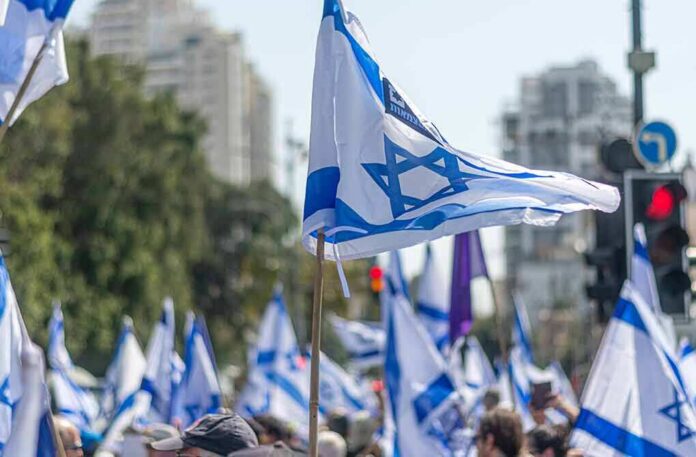
Voters just turned a war-time reckoning into a ballot-box verdict on who keeps Israel safe next.
At a Glance
- Security defines the election: continuity in war or a change in course.
- Netanyahu cites experience and a written defense on October 7 failures.
- Eisenkot offers a rival security credential and vows a full inquiry.
- Accountability and hostages sharpen the stakes for both camps.
The Ballot As A Security Briefing
Israelis voted in the first election since the October 7 attack, with security as the core issue. The vote asks a blunt question: how should military power become lasting safety? Reports framed the stakes as restoring trust in government and deciding the next phase of national defense. Supporters of Prime Minister Benjamin Netanyahu argue he is an experienced leader facing severe threats. Opponents say the deadliest security failure happened on his watch and demands new leadership.
Netanyahu’s case leans on continuity and record. His team points to decades handling Iran, Hamas, and regional shocks. He also released a 55-page response to the State Comptroller’s questions on October 7, with three pages redacted. Coverage said the document placed much blame on security officials and mapped institutional failures across the system. That approach separates the surprise of the attack from political responsibility, arguing that operational breakdowns do not prove failed strategy at the top.
The Accountability Challenge
Opponents counter with a simple frame: the worst security disaster must carry political costs. October 7 killed about 1,200 people and led to 251 hostages taken into Gaza, making accountability a centerpiece of the campaign. Critics also argue the government favored the broader war effort over rapid hostage recovery and damaged Israel’s standing abroad. Those claims keep pressure on the government to show that its war-first approach best protects citizens now and later.
Calls for an independent state commission of inquiry cut to the heart of trust. Coverage said Netanyahu rejected demands for such a commission, while challengers promised one with power to compel testimony and records. Without a completed, public investigation, voters are left to weigh competing narratives. That vacuum pushes the election to do work an inquiry would usually do: decide who bears responsibility and who designs the fix.
Eisenkot’s Direct Security Test
Former Israel Defense Forces chief of staff Gadi Eisenkot narrowed Netanyahu’s traditional edge on defense. Eisenkot emerged as a leading challenger with his own wartime credentials and a pledge to launch a state commission within days of taking office. He has argued that political leadership failed and that the public deserves a full accounting of what warnings arrived and how leaders acted on them. That stance gives voters a like-for-like security option rather than a protest vote.
Today, Israel votes. The world is watching.
The world is witnessing democracy in action in the tiny nation-state of the Jewish people, that is unfairly and disproportionately targeted for criticism and pressure at the United Nations, the African Union, the Arab League, and… pic.twitter.com/Qq3zE578Ls
— Habtom Ghebrezghiabher (@GHabtom) October 27, 2026
Coalition arithmetic still matters, but the emotional center is governance under fire. Research on past conflicts suggests that heavy losses and prolonged fighting can turn incumbency into a liability, especially when voters link the costs to leadership choices. Israeli history after the 1973 war showed that accountability shocks can reorder politics. Today’s question is similar: will continuity in war feel safer than change, or will change seem like the only path to restore deterrence and competence.
How Each Side Can Still Win
Netanyahu’s strongest play is results. If his camp shows better border readiness, fewer rocket launches, and measurable gains in regional deterrence, voters may back experience over anger. His written response to the State Comptroller, while partial in public form, gives his team a structured account of distributed failures, not a single-point collapse at the top. That frame aligns with common sense: complex systems fail in layers, and fixing them needs steady hands.
Opponents have momentum if they turn outrage into a plan the public trusts. A clear commission mandate, timelines for testimony, and a transparent warning chronology would show seriousness, not just blame. They can also promise a hostage-first strategy that explains the trade-offs in plain terms. Voters over 40 do not need slogans; they need proof someone will lock the doors, fix the alarms, and check them every night. That is a conservative instinct about duty and order.
What To Watch Next
Three tests will tell the story. First, whether a commission of inquiry becomes unavoidable after the vote, no matter who leads. Second, whether measurable security metrics improve in the months ahead, not just headlines. Third, whether a new or renewed coalition can govern without drift. Israelis did not vote to revisit talking points. They voted to decide who will carry the weight when the phone rings at 3 a.m.—and who will answer for what happens next.
Sources:
heraldtribune.com, pbs.org, nbcnews.com, npr.org, yahoo.com, ynetnews.com, observer.co.uk
© patriotnewsdaily.com 2026. All rights reserved.