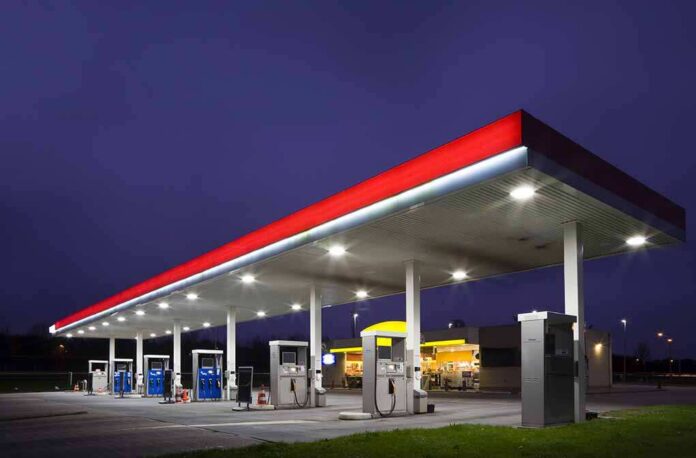
Hundreds of UK petrol stations, including major supermarkets, are breaking a new law that requires them to report live fuel prices within 30 minutes — and fines are now on the table.
Story Snapshot
- Since February 2, 2026, every UK petrol station must report pump price changes to a central government database within 30 minutes under the Fuel Finder scheme.
- Hundreds of stations, including supermarket forecourts, failed to comply during the initial grace period.
- The Competition and Markets Authority (CMA) began prioritizing enforcement and financial penalties on May 1, 2026.
- Fines can reach up to 30% of a station’s annual turnover for non-compliance.
The New Rule Every UK Petrol Station Must Follow
Since February 2, 2026, every petrol station in the UK has been legally required to report any pump price change to a central government database within 30 minutes. The rule comes from the Motor Fuel Price (Open Data) Regulations 2025. A company called VE3 Global runs the database on behalf of the Department for Energy Security and Net Zero. That data feeds directly into apps like Waze, PetrolPrices, MyRAC, and the AA app, giving drivers real-time prices before they even pull out of the driveway.
Before this law, sharing fuel price data was completely optional. Stations could charge whatever they liked and keep drivers in the dark until they were already at the pump. The Fuel Finder scheme changes that. It forces every forecourt — independent or major chain — onto the same level playing field. According to the CMA, choosing the cheapest station within a five-minute drive could save drivers of a typical family car up to £4.50 per tank.
Why the CMA Pushed for This Law in the First Place
The CMA did not create the Fuel Finder scheme out of thin air. Its own annual road fuel monitoring report found that fuel profit margins remained “persistently high” even as pump prices fell. The CMA concluded that operating costs did not explain why margins stayed elevated compared to historic levels. In plain terms, stations were pocketing more money per litre than they used to, and drivers had no easy way to push back by shopping around. The Fuel Finder scheme was the government’s direct response to that finding.
The CMA gave stations a three-month grace period after February 2 to get their systems in order. That window closed on May 1, 2026. From that point forward, the CMA confirmed it would start formal investigations and issue financial penalties against stations that still were not reporting prices correctly. Around 1,613 stations were flagged as non-compliant during the early phase of the scheme.
What Happens to Stations That Break the Rules
The enforcement process works in steps. VE3 Global, the data aggregator, contacts the station first and tries to resolve the problem directly. If the station refuses to fix the issue, or the breach is serious, the matter goes up to the CMA. The CMA can issue a formal information notice, requiring the operator to hand over documents and evidence. It can also issue a compliance notice demanding specific corrective action within a set timeframe. If those steps fail, the CMA can impose financial penalties.
Hundreds of UK Petrol Stations Breach Fuel Price Reporting Rules#UK #Fuelhttps://t.co/aDaZqhZFWL
— The British Eye (@the_british_eye) July 7, 2026
The maximum fine is set at up to 30% of a station’s annual turnover. The actual amount depends on how long the breach lasted, whether the operator tried to hide it, and the size of the business. A large supermarket chain ignoring the rule for months would face a very different penalty than a small independent station that missed a few updates. The CMA has signaled it wants to bring stations into compliance, not destroy them financially — but the teeth are real.
What Drivers Can Do Right Now
If you arrive at a petrol station and the price on the pump is noticeably higher than what an app showed you, that gap is exactly what this law is designed to catch. Drivers can report the discrepancy directly to the CMA at gov.uk/cma. Taking a timestamped photo of the forecourt price board is smart evidence to have. The government’s own Fuel Finder website also accepts reports of errors in forecourt pricing data.
Supermarket forecourts already tend to charge around 3p per litre less than the average station, saving roughly £1.50 on a full tank. But even those savings are only meaningful if the prices you see on an app are accurate. Stations that game the system by reporting stale prices — or no prices at all — undermine the entire point of the scheme. The CMA’s move to active enforcement is the right call. Transparency rules with no consequences are just suggestions, and fuel retailers have already shown they will not volunteer lower margins on their own.
Sources:
ccpc.ie, bbc.com, reddit.com, facebook.com, linkedin.com
© patriotnewsdaily.com 2026. All rights reserved.