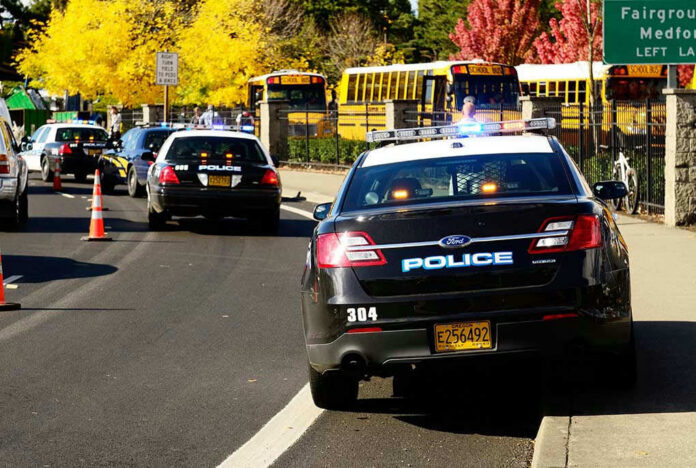
Parents came to clap for diplomas in Fairfield, California, and went home stepping around shell casings instead of confetti.
Story Snapshot
- An 18-year-old was killed and three others, including an 11-year-old child, were wounded just minutes after a high school graduation.[1][5]
- Gunfire erupted in the Fairfield High School parking lot around 7:15 p.m., as families were still streaming out of the ceremony.[1][2]
- Police launched a large-scale response and manhunt, yet announced there was “no ongoing threat” even with no suspect publicly named.[1][2][5]
- The case exposes how early crime reporting cements the “what” of a shooting long before the public ever learns the “who” or “why.”[1][5]
A celebration that turned into a crime scene in seconds
Fairfield families packed Schafer Stadium on Wednesday night to watch Sem Yeto High School seniors collect their diplomas, the kind of small-town milestone people assume is safe.[1] The ceremony ended, the crowd spilled toward the Fairfield High School parking lot, and then the first shots cracked through the evening air around 7:15 p.m.[1][2][5] Within moments, the school district’s celebration transformed into what police labeled a “large-scale incident” with medics racing through chaos.[1]
Police and emergency crews converged on the lot as panicked parents and students scrambled for cover, some dropping behind cars while others sprinted back toward the stadium gates.[2] Responding officers found four people hit by gunfire: an 18-year-old who would die at the scene and three wounded victims, ages 11, 20, and 25, rushed to local hospitals.[1][2][5] Sirens, flashing lights, and crime-scene tape quickly replaced the band music and applause that had filled the same space minutes earlier.[1][2]
The victims, the ages, and why those details matter
Reporters and police rarely have much clarity in the first hours of a shooting, but the Fairfield case produced strikingly specific victim information very quickly.[1][2][5] Authorities confirmed that the dead victim was 18, while the wounded included an 11-year-old child, a 20-year-old, and a 25-year-old.[1][2] That level of age detail, repeated across outlets the same night, suggests a solid factual core about who was hurt and underscores how far the violence reached into both childhood and young adulthood.[1][5]
Police have not said whether the 18-year-old was a student at the ceremonies, a guest, or someone else connected to the event, leaving a crucial part of the story unresolved.[1] Families watching the coverage could see the broad outline clearly—a teen dead, a child and two young adults injured—but not how or why those specific people ended up in the line of fire.[1][5] That gap shapes public anger differently: without a known relationship between victims and shooter, the event reads as senseless, which often fuels calls for tougher security and punishment.[5]
What police say, what they do not say, and why it frustrates the public
Fairfield police told the public two things that can sound contradictory if you are watching from your living room: there was a deadly shooting and an active manhunt, but “no ongoing threat” to the community.[1][2][5] Law enforcement clearly treated the case as a completed criminal act, not an active shooter roaming town, yet they offered no suspect name, no description, and no motive.[1][2][5] For many Americans, that combination feels like being told to calm down and trust a process they cannot see.
Reporters on scene pressed officials for suspect information and motive, but investigators declined to share those details, citing the ongoing investigation.[1][2] That institutional discipline is standard police practice, but it often clashes with how modern audiences expect information: instantly, visually, and in narrative form. Conservative common sense asks a blunt question here: if authorities are confident enough to say there is no continuing threat, what do they know about the shooter that they are not yet sharing, and how long are citizens expected to wait?[1][5]
Eyewitness chaos and the illusion of instant certainty
Witnesses described a sudden burst of gunfire as people were still leaving the ceremony, some recalling multiple rapid shots that sounded like a semi-automatic weapon.[2] Couples told television crews they heard a series of pops, saw people running, and only later realized they had been hearing bullets, not fireworks or noisemakers.[2] Those raw accounts give emotional weight to the story but do not yet identify who pulled the trigger, how many shooters were present, or what direction the bullets came from.[2][5]
One person was killed and three others were injured in a shooting at a high school parking lot in Fairfield following a graduation ceremony, police said. https://t.co/GYMXnFOJRN
— ABC 7 Chicago (@ABC7Chicago) June 4, 2026
Early TV segments and online posts repeated the same basic skeleton: one dead, three injured, parking lot, graduation, 7:15 p.m.[1][2][5] That repetition hardens the “event baseline” even while the shooter’s identity and motive remain largely speculation.[5] Once that baseline sets, later clarifications about accomplices, mistaken identity, or self-defense rarely get the same volume of coverage, which means the first narrative often wins the long-term memory battle regardless of nuance.[5]
What this shooting says about safety, responsibility, and narrative control
The Fairfield graduation shooting fits an increasingly familiar American pattern: a real act of violence, a stable body count, and a long, murky delay before the public learns who allegedly did it and why.[1][5] Parents who were there will not care about media theory; they will remember that their kids’ big day ended under a helicopter instead of a sunset. But for the rest of the country, this case is a reminder that the “who” and “why” often lag far behind the “what” and “where.”[5]
Common-sense citizens watching from home have reasonable expectations here: protect kids at school events, pursue criminals aggressively, and communicate clearly and honestly about what is known and what is not. Fairfield officials have confirmed the worst facts—a teenager dead, a child wounded, a gunman still unannounced—but have not yet offered the accountability story that communities crave.[1][2][5] Until that comes through court documents, forensic reports, or released video, the public will live in that uneasy space between certainty about the tragedy and uncertainty about the person responsible.[1][5]
Sources:
[1] Web – Gunfire kills teen, wounds three after US graduation ceremony
[2] Web – 1 killed, 11-year-old among 3 shot after Fairfield school graduation …
[5] Web – 1 killed, 3 others shot after a high school graduation ceremony in …
© patriotnewsdaily.com 2026. All rights reserved.