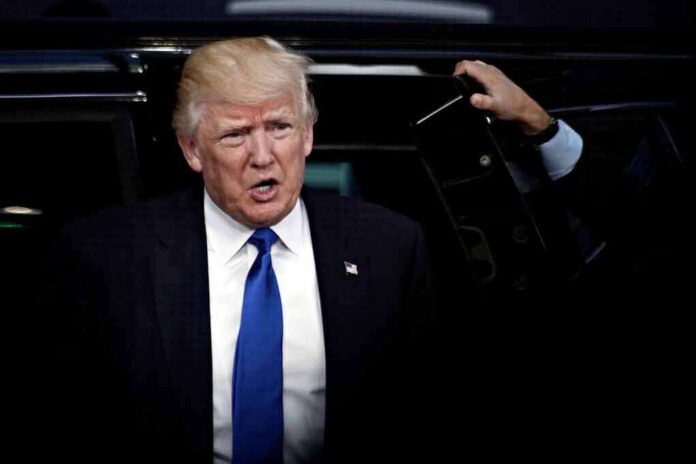
President Trump turned his own tax-leak lawsuit into a $1.776 billion test of whether government can ever make things right for citizens it has politically wronged.
Story Snapshot
- Justice Department created a $1.776 billion Anti-Weaponization Fund as part of settling Trump’s lawsuit over leaked tax returns.
- The fund promises apologies and cash relief for people who claim they were victims of political “weaponization” and “lawfare.”
- There are no stated partisan limits, but critics say the design mainly favors Trump’s allies and raises self-dealing concerns.
- The fight now centers on who qualifies as a victim, who decides, and whether the process reflects genuine justice or raw power.
Trump trades his own damages for a sweeping restitution experiment
President Trump sued the Internal Revenue Service in 2026 for leaking his tax returns to the press, seeking $10 billion in damages and accusing the government of political abuse. Rather than take a personal payout, Trump agreed to drop the case with prejudice in exchange for a new federal program called the Anti-Weaponization Fund, capitalized with $1.776 billion drawn from the existing Judgment Fund used to pay federal settlements. Trump and his co-plaintiffs receive a formal apology, but no cash from the settlement itself.
The Justice Department describes the fund as a way to hear claims from people who believe they suffered “weaponization and lawfare” and to offer them apologies or monetary relief. Officials say filing is voluntary and that there are no partisan requirements to submit a claim, meaning anyone who thinks politics drove their prosecution can apply. That framing lets Trump cast his decision as a sacrifice of personal damages in favor of broader restitution for others who say the government turned its power into a political weapon.
How the Anti-Weaponization Fund is supposed to work
The Attorney General gave the fund authority to issue formal apologies and cash payments to approved claimants, with quarterly reports to the Attorney General listing who was paid and how. Money comes from the Judgment Fund, a standing pool Congress already created so the government can pay legal claims without separate votes each time. The program is time-limited; it must stop processing claims by December 1, 2028, and any leftover funds go back to the federal government. That structure lets the administration act quickly, without waiting for new legislation.
Acting Attorney General Todd Blanche told Congress the fund offers “a lawful avenue” for victims of lawfare and weaponization to be acknowledged and seek redress. In practice, a new commission will review claims and decide who qualifies. Blanche has said Trump and his family will not receive payouts, even though their lawsuit triggered the fund. That detail matters for conservatives who value rule of law over personal gain; Trump can argue he used his leverage to fight for others, not for another check to his own businesses.
Who counts as a victim and why the definition matters
The most sensitive question is who will be treated as a victim of “weaponization.” The Justice Department’s own materials use broad terms but do not spell out a precise standard. That opens the door to people ranging from conservative activists and former officials to January 6 defendants who say they were charged for political reasons rather than for their actions alone. Blanche refused to rule out payouts for individuals involved in the Capitol riot, saying anyone who believes they were a victim can apply.
From an American conservative values perspective, the core idea is simple: when government power is misused to punish citizens for their beliefs instead of their crimes, those citizens deserve restitution. Turning that principle into a fair program is harder. A vague standard can invite opportunists and undermine respect for real victims. Critics argue that treating violent offenders as “weaponization” victims cheapens both justice and the suffering of people who were truly targeted for speech or association rather than wrongdoing.
Supporters see justice; critics see a dangerous precedent
Supporters on the right frame the fund as long overdue accountability for the years when agencies like the Internal Revenue Service, the Justice Department, and intelligence services were seen as tools against political outsiders. They point to leaks of Trump’s tax records, the Russia-collusion saga, and aggressive prosecutions of Trump-aligned figures as proof that the “deep state” needs more than a slap on the wrist. In their view, a dedicated restitution fund tells future bureaucrats that abusing power has a price.
When government unlawfully weaponizes its power against citizens, those victims deserve restitution. Trump waived his own claim to the benefit of others targeted by Biden's DOJ. Cornyn’s objection surfaced only after his political defeat. Accountability should not depend on party… pic.twitter.com/rWyMVtbzDN
— Jared Matthew Sewell (@JaredMSewell) July 31, 2026
Democrats and many legal scholars call the fund corrupt, unconstitutional, or a “slush fund,” arguing it lets a sitting president use taxpayer money to reward allies. They warn that tying a personal lawsuit to a huge pool of politically framed payouts blurs the line between impartial justice and presidential patronage. Some also highlight clauses that reportedly limit future audits into Trump’s finances, saying that shielding the president’s business interests while compensating his supporters looks more like self-protection than neutral reform.
Bigger picture: government restitution, self-dealing, and what comes next
Historically, federal compensation programs created in hot political climates rarely fail over the idea of restitution itself. They break down over who qualifies, who controls the process, and whether the rules feel even-handed across party lines. By using open-ended language about “weaponization” and “lawfare,” the Trump administration tapped into real grievances but also set up a likely long-term fight over definitions. Lawfare experts already compare this fund to past abusive settlements where executive-branch lawyers stretched existing powers for political ends.
For conservatives, the challenge is balancing two instincts: demanding justice for citizens bullied by politicized prosecutions, and guarding against any president using the same language to funnel benefits to friends. The Anti-Weaponization Fund sits exactly on that line. If it focuses on clear cases of government overreach, it could signal that Washington finally takes its own misconduct seriously. If it becomes a broad cash stream for everyone with the right politics and a lawyer, it will only prove that when power is weaponized, it rarely disarms itself for long.
Sources:
facebook.com, youtube.com, nypost.com, nbcnews.com, wral.com, abcnews.com
© patriotnewsdaily.com 2026. All rights reserved.