Nothing on the National Mall has ever delivered quite the collective whiplash as the sudden, unexplained arrival of a statue depicting Jeffrey Epstein and Donald Trump hand in hand—leaving a nation asking not just who, but why, and what comes next.
Story Snapshot
- A statue of Epstein and Trump holding hands appears overnight on federal land, igniting instant controversy.
- Social media and news outlets race to piece together the statue’s origins and meaning, fueling speculation and outrage.
- Authorities launch investigations and ultimately remove, or fail to protect, the unauthorized installation.
- The episode spotlights the power of guerrilla art, viral misinformation, and the American appetite for scandal and spectacle.
Guerrilla Art’s Provocation: When Public Spaces Become Battlegrounds
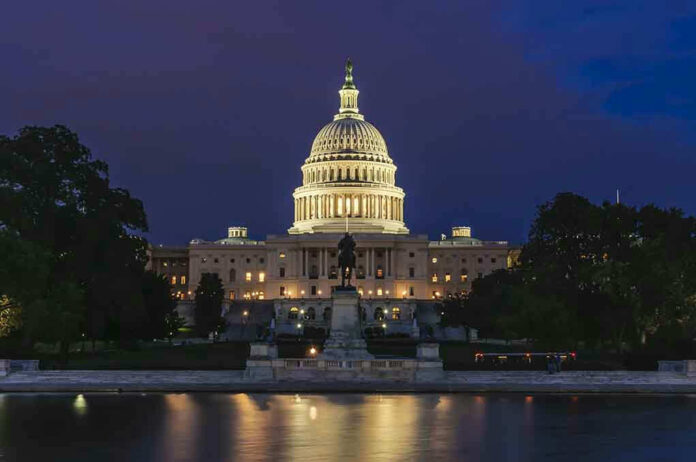
Statues on the National Mall have always been deliberate, solemn, and symbolic. This latest, mysterious addition upended that tradition with a single, provocative gesture: two notorious figures—Epstein and Trump—immortalized in bronze, hands clasped, standing where presidents and patriots are typically honored. The installation bypassed every layer of regulation, catching authorities, locals, and tourists entirely off guard. The immediate effect was visceral: passersby snapped photos, activists and critics began speculating, and security scrambled to cordon off the area—leaving the nation’s front yard transformed into a stage for political art and public outrage.
Within hours, viral images and breathless commentary spread across every social media platform. Questions about the artists’ motives mingled with conspiracy theories and partisan accusations. For some, the statue was a raw, necessary confrontation with uncomfortable truths about power and complicity; for others, it was the latest example of disrespectful protest art, designed to humiliate rather than illuminate. Meanwhile, the most basic facts—who installed it, how they managed federal security, and whether the sculpture was even legal—remained unanswered, fueling the sense of chaos and spectacle.
Epstein, Trump, and America’s Appetite for Symbolic Scandal
Jeffrey Epstein’s name evokes a labyrinth of criminality and elite connections, while Donald Trump’s legacy is defined by political division and relentless media scrutiny. Their combined depiction in public art weaponized both their notoriety and the nation’s obsession with scandal. The statue’s appearance forced a reckoning with unresolved questions: How should public spaces address the misdeeds of the powerful? When does protest art cross the line from commentary to defamation? For survivors of abuse and Trump supporters alike, the statue felt personal—an affront or a reckoning, depending on perspective. The emotional aftershocks rippled far beyond Washington, D.C., through every community forced to confront the uneasy overlap of art, justice, and celebrity culture.
Media outlets, eager for clicks and controversy, amplified the spectacle by featuring expert opinions from art critics, legal scholars, and political commentators. Art experts hailed the installation as a bold, if illegal, provocation—arguing that guerrilla art has always served as a mirror for society’s darkest secrets. Legal authorities, on the other hand, reminded the public that the National Mall is not a free-for-all canvas; unauthorized installations violate federal law and can result in criminal charges, setting the stage for a legal showdown as inevitable as it was contentious.
Who Wins, Who Loses, and Who Decides the Narrative?
The fallout from the statue—whether it is removed by dawn’s early light or left to weather the public’s fury—offers a revealing glimpse into the power struggles that define public discourse. Artists and activists gain global attention, even as authorities work to erase their handiwork. The media act as both amplifiers and arbiters, shaping narratives and fueling further division. For everyday Americans, the episode is a litmus test of values: free speech versus respect for the law, accountability versus spectacle, the right to protest versus the right to be left alone in the nation’s most sacred public space.
Mysterious new statue of Epstein and Trump holding hands appears on the National Mall. Trump has apparently installed a statue of himself and Epstein holding hands in DC. https://t.co/mYIdAG51pg
— Mike Drescher (@drescher_m76041) September 24, 2025
The incident’s legacy will likely be debated for years. Will it inspire tighter restrictions and surveillance of public art? Will it spark new movements demanding accountability for the powerful? Or will it simply drift, as so many viral moments do, into the collective memory—an odd footnote in America’s long, complicated relationship with scandal and symbolism? For now, one thing is clear: the lines between art, protest, and misinformation have never been blurrier, nor more consequential, than in the shadow of the National Mall.
Sources:
Statue of President Trump and Jeffrey Epstein titled ‘Best … — CNN
Trump, Epstein hold hands in protest sculpture on National … — USA Today
Mysterious new statue of Epstein and Trump holding hands … — Yahoo News
Statue of Trump and Epstein holding hands placed on … — Washington Post