Four tourists in a burned-out car, a right-hand steering wheel, and officials saying “could be British” turned one of Spain’s deadliest wildfires into a grim lesson about how fast tragedy and uncertainty now cross borders.
Story Snapshot
- A fast-moving wildfire in Andalusia killed at least 11 people, with 19 still listed as missing.
- Regional emergency authorities say four of the dead appear to be British nationals, found in a single burned car.
- Officials and media keep using careful words like “could be” and “feared to be,” showing the facts are not fully locked in yet.
- The case fits a wider pattern where early reports about foreign victims in European wildfires are often revised after forensic work.
Deadly Fire In A Tourist Landscape
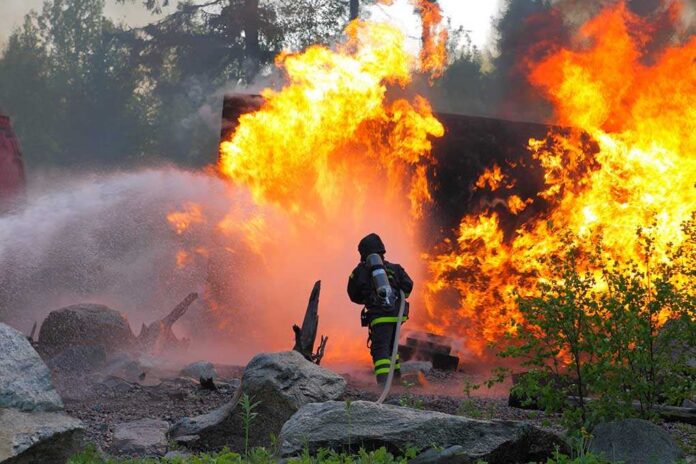
The wildfire broke out in the Almería province of Andalusia, a part of southern Spain known more for sun, golf courses, and cheap flights than for disaster scenes. Flames moved fast through dry hills and roadside scrub, pushed by heat and wind that had built up over days. Authorities say at least eleven people died as they tried to flee either in cars or on foot, against advice to shelter in safer areas. At least nineteen more remain missing, and that number alone tells you the story is not finished yet.
For older readers who grew up when a “Spanish holiday” meant a package trip and a beach towel, the setting matters. This was not a remote forest where only locals go. Regional officials describe victims found on highways and near vacation homes, people who likely believed they could outrun the fire. Reports mention evacuation orders that some ignored or did not receive in time, echoing a hard truth from other disasters: freedom also means you bear risk if you misjudge danger.
Four Bodies, A Right-Hand Wheel, And A Tentative British Link
The detail that grabbed headlines was a burned-out car with four bodies inside and a steering wheel on the right side, the layout common in Britain. Regional emergency authorities said early indications suggest these four victims were British nationals, and several outlets repeated that phrase. A Spanish government official told a major breakfast news program that four victims “could be British,” again stressing possibility, not final proof. One regional leader also referenced four British nationals among the dead when briefing media.
For many people, that was enough to fix a picture in their minds: British tourists trapped in their car on a Spanish road, caught between fire and confusion. But from an evidence point of view, that is still an educated guess. A right-hand steering wheel strongly points to the United Kingdom, yet it does not guarantee it. Other countries have right-hand drive cars, and import markets are messy. Conservative common sense here says respect the probability but wait on paperwork, not feelings, to decide national identity.
Why Officials Talk In Careful, Frustrating Language
Some readers roll their eyes when they hear phrases like “could be British” or “feared to be tourists.” It can sound like bureaucrats dodging clarity. In reality, this is what responsible speech looks like in the first days after a fire. Authorities must match bodies to passports, work through dental records and DNA, and contact families before they state nationalities as settled fact. When they speak sooner, they lean on circumstantial clues, like vehicle type or where people were found.
Research on recent wildfires in southern Europe shows a pattern. Early claims about nationality, especially involving tourists from Britain, Germany, or Scandinavia, surface within the first forty-eight hours. Many of those claims later get revised once forensic teams finish their work. That does not mean the initial reports are lies. It means they are snapshots taken through smoke. Older, more skeptical readers should see the careful wording not as weakness but as a sign that officials know the difference between a strong hint and a proof.
Were Most Victims Foreigners, Or Is That Just The Storyline?
Several headlines push the idea that “most” of the victims were foreigners, or that this was especially a British tragedy. The actual on-record facts are narrower. Authorities say at least eleven people died, with regional sources mentioning four who appear to be British or are feared to be British tourists. Beyond those four, no detailed breakdown of nationality has been made public yet. Media pieces that mention twelve deaths show the count itself is still being cleaned up.
Tragedy in Spain: The #LosGallardos wildfire in Almería is now the deadliest in Andalusia's history, claiming 12 lives during a 40°C heatwave. Several victims, including British tourists, were trapped in cars after fleeing safe zones. #Andalusia #SpainWildfires #Almeria #Bedar pic.twitter.com/8XfAaQ413c
— European Union club (@TheEuropeanUC) July 10, 2026
So the honest answer today is simple: foreigners did die, and four of them may well be British tourists, but no official tally has proved that “most” victims were from outside Spain. The draw to highlight foreign victims is strong because it turns a regional disaster into an international story and grabs attention. A conservative reading of the facts pushes back. Grief does not need a passport ranking. Until death certificates, passport records, and forensic reports come out, claims about “mostly foreigners” deserve a raised eyebrow.
Heat, Risk, And The Hard Lessons For Travelers
This wildfire did not happen in a vacuum. Climate studies on Spain link hotter, drier, windier summers to a higher chance of large fires, especially in coastal regions that attract seasonal visitors. Local vulnerability research shows that people who are new to an area, like tourists or part-time residents, are more likely to misread escape routes or ignore local advice. That mix matters in Andalusia, where foreign visitors often use rental cars and rely on phone maps instead of old-fashioned local knowledge.
For travelers and retirees who spend time abroad, the takeaway is direct. Wildfires are now part of the real risk landscape, not a remote problem for rural villagers. When sirens sound or officials say “do not flee by car,” that is not nanny-state meddling. It is experience speaking from past deaths. Cross-border life means cross-border responsibility. The Almería wildfire, and the four bodies in that right-hand-drive car, remind us that comfort and freedom do not erase the need for judgment when nature turns hostile.
Sources:
facebook.com, ottumwacourier.com, yahoo.com, alloaadvertiser.com, gamereactor.eu, ground.news
© patriotnewsdaily.com 2026. All rights reserved.