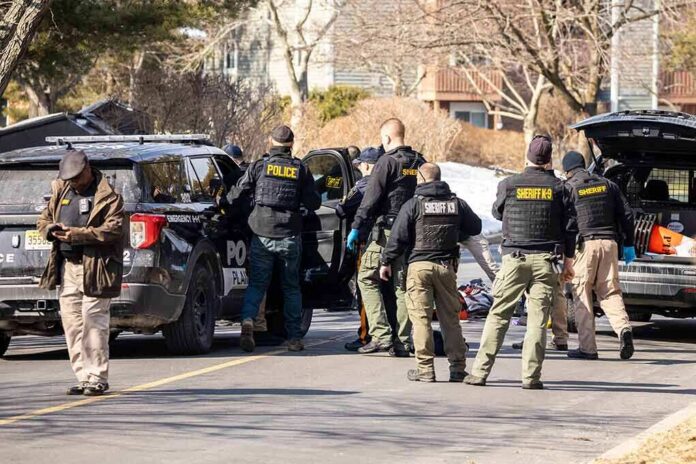
Body-camera video, a frantic 911 call, and a car in motion set the split-second test that cleared two Colorado officers in a deadly Dairy Queen shooting.
Story Snapshot
- Investigators ruled the shooting legally justified under Colorado’s self-defense and defense-of-others standard.
- Police say Patti Wilson stabbed a customer, fled to a car, and created an immediate threat as officers moved in.
- Critics cite video angles that suggest the car was turning away when shots were fired.
- The two officers were named as Zachary Diaz and Tim Long; no charges were filed.
The Case File That Closed The Door On Charges
The 21st Judicial District’s Critical Incident Response Team delivered the key finding: both Grand Junction patrol officers, Zachary Diaz and Tim Long, acted within the law when they used deadly force in a Dairy Queen parking lot on June 19, 2026. The district attorney accepted the conclusion that the officers reasonably believed deadly force was needed to defend themselves and others from imminent harm at that moment. No criminal charges were filed as a result of that review.
Investigators anchored their decision in two facts the public can verify. First, a stabbing inside the restaurant. Second, body-camera footage capturing the rush outside to a car in motion with officers on foot. The official account states that Wilson had already stabbed a victim inside the Dairy Queen and then moved to flee, turning the vehicle into an immediate hazard around people and police. That sequence, paired with officer statements, met the legal threshold under Colorado law.
What The Videos Show And Why Angles Matter
Local outlets reported that one body-camera view suggests Wilson was not steering directly at the officers when they opened fire, which fuels debate about the exact degree of threat. A bystander clip cited by a columnist also claims an officer aimed toward passing traffic while shooting at the moving car. Those details shape public concern, but they do not replace the legal test that governs split-second force decisions on a dynamic scene.
Two ideas can be true at once. A car may not be pointed head-on and still pose a deadly risk at close range. Officers on foot do not need to wait for a fender to touch their legs before they act. From a common-sense view, a two-ton vehicle near people can become a weapon in a blink. That risk calculus, not a perfect video angle, decides whether an officer faced imminent danger in that instant.
Names, Timeline, And The Charging Decision
The Grand Junction Police Department identified the two officers who fired as patrol officers Zachary Diaz and Tim Long soon after the incident. Media reports place Wilson’s age at 31 and confirm the fatal outcome from gunshot wounds. The district attorney’s office later issued its no-charges decision after the Critical Incident Response Team finished interviews, evidence review, and a frame-by-frame look at the video record.
🚨 EXCLUSIVE: Officers cleared after shooting transgender person who stabbed elderly customer at Grand Junction over a Cherry Coke
After stabbing an elderly customer and attempting to flee the Dairy Queen, Anthony Wilson, aka Patti, reversed, attempted to strike an officer with… https://t.co/XCbSuXKHR5 pic.twitter.com/ogU8T1q5Sr
— The Facts Dude 🤙🏽 (@Thefactsdude) November 17, 2026
One report stressed that body-camera footage appears to show the car moving but not directly at the officers at the precise start of gunfire. That observation deserves attention. It does not, by itself, end the legal question. The standard remains what a reasonable officer perceived and whether less force would have stopped a serious and immediate threat. On that narrow test, the district attorney concluded the officers met the threshold and declined charges.
How To Read Split-Second Police Cases Without Getting Lost
Use three filters when you watch clips like these. First, sequence: what happened right before the first shot often decides everything. Second, distance and movement: cars, even angled away, can pivot or surge in a second and crush someone. Third, bystanders: officers must weigh the risk to the public if a fleeing suspect escapes into traffic. From a conservative, public-safety lens, stopping a clear violent actor before wider harm aligns with duty and common sense when the clock is down to heartbeats.
Sources:
thegatewaypundit.com, gjsentinel.com, kjct8.com, westernslopenow.com
© patriotnewsdaily.com 2026. All rights reserved.