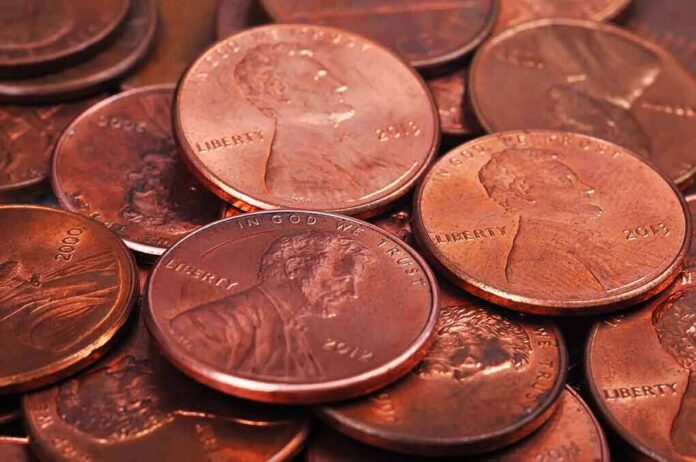
Congress just voted to send the penny from your pocket to the history books—and your change now rounds to a nickel.
Story Snapshot
- House and Senate passed the Common Cents Act to stop minting pennies for circulation.
- Treasury must halt general penny production within one year of enactment.
- Cash totals may be rounded to the nearest five cents under stated rules.
- Existing pennies remain legal to use in everyday payments.
What Congress Passed And What It Means
Lawmakers approved the Common Cents Act to end general production of the one-cent coin, with bipartisan votes in both chambers. The House advanced H.R. 3074 in July, led by House Republican Conference Chairwoman Lisa McClain, with messaging centered on waste and simplicity. The Senate cleared its companion, S. 1525, by unanimous consent on August 7. The text directs the Treasury to stop minting pennies for circulation, while still allowing numismatic sales for collectors.
The House bill sets a one-year clock from enactment for Treasury to cease penny production. That timeline builds room for the United States Mint to wind down supply and manage contracts. It also supports a smoother handoff to merchants and banks as drawers clear and coins recirculate. Congress framed the change as housekeeping: keep money honest, stop paying more than one cent to make a cent, and save time at the register without spiking prices.
How Checkout Will Handle Your Change
The policy allows rounding of cash totals to the nearest five cents, keyed to the final digit of the amount due. Under the House text, totals ending in one, two, six, or seven cents round down; ending in three, four, eight, or nine cents round up. The rule applies to cash after tax, not to listed prices, and not to cards. Debit and credit still pay exact cents. Canada used the same approach a decade ago and kept the penny as legal tender while it faded out.
Consumers who use cash will notice small swings of a cent or two per purchase. Over many transactions, symmetric rules tend to even out. Federal Reserve research describes the likely effect on overall prices as small, because most payments are not cash and rounding cuts both ways. Some studies claim larger “rounding tax” effects, but those estimates depend on narrow assumptions about merchant behavior that have not shown up in broad practice.
What Stays The Same For Your Old Pennies
Every penny in your jar still spends. The bills make clear that existing one-cent coins remain legal tender. Banks may accept them. Stores can take them. The difference is future minting for general use stops, and the float shrinks over time as people save, lose, or redeem coins. The Senate text also preserves a lane for the Mint to strike special one-cent coins for collectors, so the design lives on in the hobby world even as cash drawers move on.
Merchants will adjust cash drawers, point-of-sale settings, and signs. Banks will update coin orders and vault practices. Most of this is routine. Other countries have done it quickly and cleanly, with clear point-of-sale guidance and customer notices. The House committee process highlighted the same goals: reduce waste, cut wait times, and remove a coin that costs more than it is worth to make.
The Conservative Case: Stop Paying A Nickel To Mint A Penny
Congress accepted a common-sense trade: stop subsidizing a coin that no longer pulls its weight, and keep the market moving. That aligns with a leaner government and a cleaner checkout counter. The House message stressed spending discipline and time savings. The Senate’s unanimous consent speaks to broad agreement that a century-old habit is not a policy plan. Shoppers keep choice; exact-cent payments still work on cards; cash customers see even-handed rounding at the end.
Congress Passed the 'Common Cents' Act Moving the Penny Into Numismatic and Linguistic History https://t.co/fqZFRIjBQf
— Becca Lower (@BeccaJLower) September 15, 2026
Two cautions remain on the mechanics. The Senate passed its bill with an amendment, and summaries differ on whether rounding is required or optional. The final enrolled text will lock that down, but the core path is set: no new pennies for daily change, legal-tender status preserved, and a rounding framework that matches peers like Canada. The Mint and Treasury will now carry the ball to the finish line within the statutory window.
Sources:
congress.gov, mcclain.house.gov, yahoo.com, foxnews.com, papers.ssrn.com, libdcms.nida.ac.th
© patriotnewsdaily.com 2026. All rights reserved.