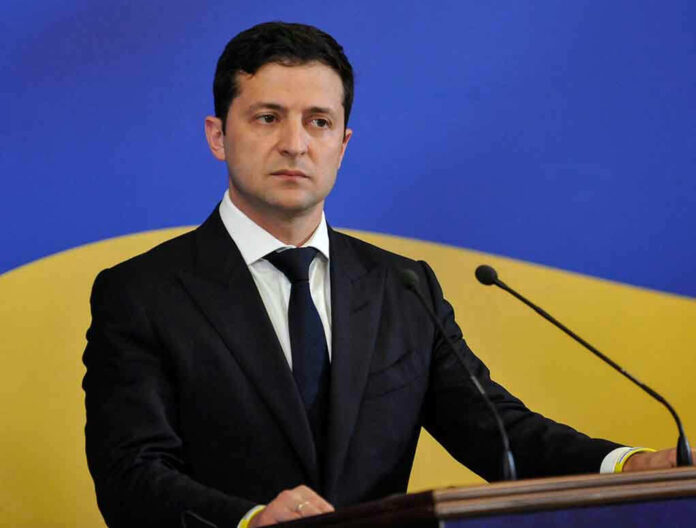
Ukraine’s president just watched his approval rating collapse nearly 40 points in weeks, and his closest political ally has been forced to resign amid allegations of stealing $100 million meant for energy infrastructure during wartime.
Quick Take
- Andriy Yermak, Ukraine’s chief of staff and second-most powerful official, resigned November 29, 2025, following raids by the National Anti-Corruption Bureau investigating a massive embezzlement scheme
- The scandal implicates multiple high-ranking ministers and business associates in a $100 million theft from energy sector contracts during active Russian bombardment
- Zelensky’s approval rating has collapsed to below 20 percent as Ukrainians discover government officials stole resources meant to protect civilians from missile attacks
- The timing creates diplomatic complications as Ukraine negotiates peace terms with the Trump administration, with Yermak serving as lead negotiator
When Wartime Corruption Becomes Political Catastrophe
Andriy Yermak occupied a position of extraordinary power in Ukrainian politics. As Zelensky’s chief of staff, he functioned as the primary architect of executive authority, controlling access to the president and directing policy implementation across government agencies. His forced resignation on November 29, 2025, represents far more than the departure of a single official—it signals institutional collapse at Ukraine’s highest levels during a moment of maximum vulnerability.
The National Anti-Corruption Bureau’s investigation, codenamed “Operation Midas,” exposed a systematic embezzlement scheme involving approximately $100 million diverted from energy sector contracts. Government officials allegedly received kickback payments ranging from 10 to 15 percent of contract values from contractors building fortifications on Ukraine’s critical infrastructure. The timing makes the theft particularly devastating: these funds were designated for energy infrastructure repairs needed to protect civilians from Russian missile attacks and winter blackouts during active warfare.
The Network of Obligation and Enrichment
The scandal reveals how Zelensky’s rise to power created networks of mutual obligation that later enabled corruption. Yermak, a former television producer with no prior political experience, entered politics through business relationships with Timur Mindich, co-owner of Zelensky’s former television studio Kvartal95, and oligarch Igor Kolomoysky. These relationships, forged in the entertainment business, became the foundation for political power and, allegedly, systematic theft.
Mindich’s flight to Israel before anti-corruption authorities could raid his residence suggests awareness of legal jeopardy. Energy Minister Svitlana Hrynchuk and Justice Minister Herman Halushchenko have already resigned following the investigation’s expansion. Former Deputy Prime Minister Oleksiy Chernyshov remains named in the investigation. The scandal extends beyond isolated individuals to encompass a network of officials operating within Zelensky’s inner circle.
The Approval Rating Collapse Nobody Saw Coming
Zelensky’s domestic political position has deteriorated with stunning speed. His approval rating has fallen from approximately 60 percent to below 20 percent—the lowest mark since his 2019 election victory. For the first time since Russia’s invasion began, more Ukrainians distrust than trust their president. This represents a fundamental loss of legitimacy precisely when national unity remains essential for both military effectiveness and diplomatic negotiations.
The public anger stems from a specific betrayal: government officials falsely promised democracy and freedom while simultaneously enriching themselves through embezzlement of resources meant to protect civilians. Ukrainians enduring Russian missile attacks and winter blackouts discovered that their government had stolen the money designated to defend them. The contradiction between official rhetoric and revealed reality has created what observers describe as immense anger and disgust among the population.
Diplomatic Vulnerability at a Critical Moment
Yermak served as Ukraine’s lead negotiator in peace discussions with the Trump administration regarding potential settlement terms for Russia’s war in Ukraine. His forced resignation removes the primary architect of Ukraine’s diplomatic strategy at precisely the moment when negotiations remain active and Ukraine’s leverage appears limited. The scandal creates uncertainty about continuity in negotiating positions and potentially weakens Ukraine’s bargaining power.
The timing creates additional complications for Ukraine’s international standing. The scandal allows Russia to draw distinctions between Ukraine and more authoritarian regimes, undermining Ukraine’s self-presentation as a democracy worth supporting. For American policymakers and European allies, the corruption revelations complicate justifications for continued military and financial aid, particularly as domestic political support for Ukraine assistance faces increasing scrutiny in Washington.
The Institutional Independence Question
In July 2025, Zelensky attempted to limit the power of the National Anti-Corruption Bureau and the Specialised Anti-Corruption Prosecutor’s Office, justifying the move as necessary to combat Russian influence. This action preceded the major corruption revelations by several months and suggests Zelensky may have possessed awareness of embezzlement within his government. The anti-corruption agencies’ persistence in pursuing investigations despite executive pressure demonstrates that institutional independence, though fragile, retains some resilience even under conditions of existential military threat.
Zelensky reportedly attempted but failed to negotiate a truce with anti-corruption officials following the scandal’s outbreak. The agencies’ refusal to accept executive pressure indicates boundaries that even a wartime president cannot easily cross. Whether these institutions can maintain independence as the investigation potentially expands to implicate Zelensky himself remains the central question facing Ukrainian governance.
Sources:
World Socialist Web Site – Ukraine corruption scandal reporting