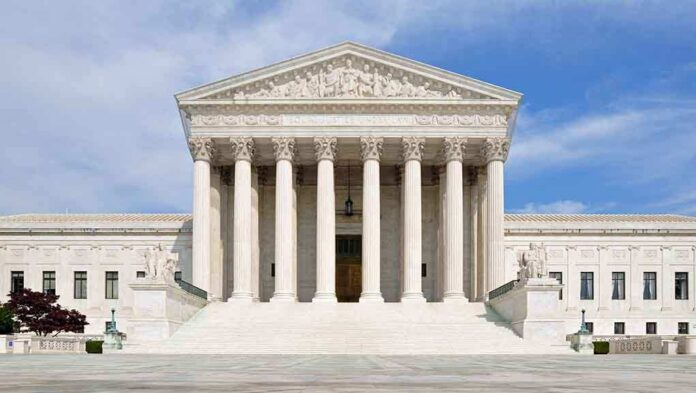
The Supreme Court’s quiet “no” to one Ohio candidate sent a loud message: a party primary is not a costume party.
Quick Take
- Samuel Ronan, a self-described progressive and former DNC chair candidate, tried to run in an Ohio Republican primary for Congress.
- Ohio election officials knocked him off the ballot under a “good faith” party-affiliation rule aimed at preventing sabotage and fraud.
- Federal courts sided with Ohio, and the U.S. Supreme Court refused to put him back on the ballot before early voting.
- The dispute spotlights a hard question: when does voter choice end and election manipulation begin?
Ohio’s “Good Faith” Rule Collides With a Strategy to “Trick” Voters
Samuel Ronan filed to run as a Republican in Ohio’s 15th Congressional District, the Columbus-area seat held by Rep. Mike Carey. The friction started when opponents pointed to Ronan’s public statements describing a plan to run Democrats in deep-red districts to “trick” GOP voters and “get a foot in the door.” Ohio law requires a primary candidate to declare party affiliation in good faith, and officials treated the words as the whole ballgame.
That phrase “good faith” sounds squishy until you see how Ohio runs partisan primaries. The state doesn’t treat them as open public auditions where anyone can borrow a label for convenience; it treats them as internal party selection with rules meant to protect the party’s associational rights and protect voters from deliberate misrepresentation. Ronan’s case turned less on ideology than on a basic question of truthfulness: what did he sign, and did he mean it?
The Trigger Wasn’t a Party Boss; It Was One Voter With Receipts
A local Republican voter, Mark Schare, lodged a protest to the Franklin County Board of Elections and backed it with public material, including social media and interview clips. That detail matters because it undercuts the easy storyline that “the establishment” simply smothered a challenger. This challenge came from the ground up, the way election accountability is supposed to work: a citizen points to evidence, election officials apply the statute, and courts review the result.
Ohio Secretary of State Frank LaRose ultimately disqualified Ronan. The state’s posture was straightforward: if a candidate signs a declaration under penalty of falsification, the state has a duty to treat that as more than a symbolic gesture. Conservatives should appreciate the logic even when it stings: elections depend on enforceable representations, not vibes. A system that shrugs at false filings invites the kind of procedural gamesmanship that makes ordinary voters cynical and disengaged.
Ronan’s First Amendment Argument Hit a Wall: Speech Rights Don’t Cover False Attestations
Ronan sued in federal court, arguing that removing him from the ballot violated the First Amendment. Chief U.S. District Judge Sarah D. Morrison rejected that claim, emphasizing the state’s substantial interest in preventing fraudulent declarations and maintaining the integrity of party primaries. That reasoning tracks common sense: the Constitution protects political advocacy; it does not grant a right to sign sworn paperwork you don’t mean and then demand a court treat the signature as optional.
The federal appeals court refused to restore Ronan to the ballot, leaving him to seek emergency relief from the Supreme Court as early voting approached. Timing mattered because ballot disputes become real-world chaos once voting starts. Courts tend to move cautiously in that window, not out of cowardice, but because last-minute judicial rewrites can confuse voters, burden administrators, and create unequal treatment across counties. Ronan needed a fast win; the courts moved the other direction.
The Supreme Court Denial Was Brief, but the Signal Was Clear
Justice Brett Kavanaugh referred Ronan’s emergency request to the full Court, and the Court denied it without explanation. That’s normal on the emergency docket, but the outcome still speaks: the justices did not see a must-fix constitutional emergency in Ohio enforcing its primary rules. Americans who want clearer election lines should recognize what this effectively affirms—states can require that party-label claims in a partisan primary carry real meaning.
Critics call this “ballot access” suppression; supporters call it anti-fraud enforcement. The facts lean toward enforcement. Ronan wasn’t blocked for holding unpopular views; the dispute centered on whether he misrepresented his party identity to access a Republican ballot. Election systems fail when they reward cleverness over candor. From a conservative values lens—rule of law, institutional integrity, and respect for voters—the state’s insistence on honest affiliation looks less like gatekeeping and more like basic hygiene.
Why This Case Matters Beyond One Ohio District
Every cycle brings new “tactics” dressed up as activism: spoiler runs, strategic party-switching, and social-media-driven campaigns to game low-information contests. Ohio’s good-faith requirement aims to draw a bright line: if you want to change a party, join it sincerely and live with the consequences, rather than treating the primary as a prank. That principle protects the rank-and-file voter—the retiree filling out a ballot—more than it protects politicians.
Other states watch these outcomes closely, especially where primaries decide the real winner. Nebraska’s separate dispute involving a good-faith challenge shows the concept isn’t isolated to one party or one geography. The larger issue is whether parties remain meaningful voluntary associations or become open platforms vulnerable to organized deception. Voters can handle ideological disagreement. What they can’t defend against is a candidate who treats the label itself as a weapon.
Supreme Court REJECTS Appeal from So-Called ‘Republican’ Candidate After Being Exposed as a Democrat Plant https://t.co/0xFrXkr3ra #gatewaypundit via @gatewaypundit
— TRUMPGIRL (@TRUMPGIRL_STL) April 10, 2026
The Supreme Court didn’t write a sermon, but the practical takeaway is sharp: if a state builds guardrails to keep primaries from turning into sabotage contests, federal courts may let those guardrails stand. The result won’t end political games, but it raises the cost of running them. For voters, that’s the point. A primary ballot should tell the truth about what it claims to be: a party choosing its own nominee, not a stage for ideological identity theft.
Sources:
Supreme Court rejects GOP challenge to California’s new election map
Supreme Court blocks candidate after alleged GOP infiltration scheme exposed
California Republicans respond to Supreme Court loss on election maps
Nebraska Democratic US Senate candidate Burbank stays off ballot after case dismissal for now
Supreme Court keeps former DNC candidate off Ohio GOP primary ballot