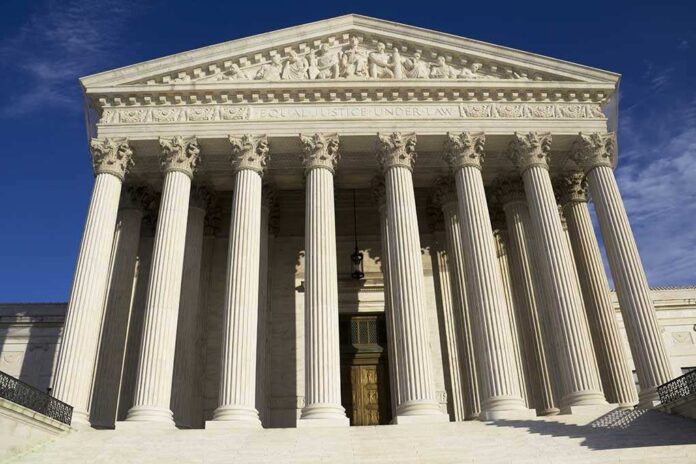
The Supreme Court just handed Republicans a game-changing victory by reinstating Texas’s pro-GOP congressional map—overriding a lower court’s finding of blatant racial gerrymandering just weeks before midterms.
Story Snapshot
- Supreme Court stays lower court block, allowing Texas’s 2025 map for 2026 elections despite racial gerrymander ruling.
- Texas legislature drew map targeting Democratic “coalition” districts with precise racial thresholds from Justice Department directives.
- District court cited strong evidence of race predominance; Supreme Court prioritizes election stability via shadow docket.
- Potential shift: Republicans gain up to 5 seats in Texas, bolstering House majority amid national redistricting battles.
- Dissent warns of disservice to millions of Texans reassigned by race, signaling higher bar for pre-election challenges.
Texas Legislature Enacts Controversial 2025 Map
Texas lawmakers approved the 2025 congressional map in late August 2024, responding to Justice Department claims that existing districts violated anti-gerrymandering laws. Governor Greg Abbott signed the plan, engineered to deliver Republicans 30 of 38 seats, up from 25. The map dismantled Democratic-held “coalition” districts—those with over 50% non-white voters without a single majority group. Lawmakers used racial targets like 50% Black or Hispanic citizen voting-age populations to redraw lines.
District Court Rules Map Unconstitutional
A three-judge panel, led by Judge Jeffrey Brown, blocked the map on November 18, 2025, after a full trial. The 160-page opinion found race predominated over partisan goals, citing three key evidences: Justice Department racial targets triggered redistricting, governor communications stressed race, and no viable race-neutral alternatives existed. Judge Jerry Smith dissented, arguing pure partisanship shields the map under Supreme Court precedent like Cooper.
Supreme Court Intervenes on Shadow Docket
The Supreme Court granted an emergency stay on December 4, 2025, in Abbott v. LULAC (25A608), restoring the map pending full review. Justice Samuel Alito noted the redistricting stemmed from “partisan advantage pure and simple,” permissible under precedents. The unsigned order criticized the district court for disrupting elections near candidate filing deadlines, invoking the Purcell principle against eve-of-election changes. This rare pre-election override preserved Texas’s lines for 2026 midterms.
Stakeholders Clash Over Racial Predominance
Texas Republicans defend the map as compliance with federal directives, securing House control. Plaintiffs, including League of United Latin American Citizens, represent Latino voters alleging vote dilution. The conservative Supreme Court majority favored stability; liberal dissenters, led by Justice Elena Kagan, argued the stay disserves millions reassigned by race. Lower court fact-finding deserved deference, they wrote, as precedents demand strict scrutiny when race drives lines.
🚨 BREAKING: Supreme Court hands Republicans a redistricting win by striking down lower court block on Texas map pic.twitter.com/0V9MXFzRCv
— Fox News (@FoxNews) April 27, 2026
Impacts Reshape National Political Landscape
Short-term, Republicans campaign under favorable lines, potentially flipping 5 Texas seats and aiding House majority. Long-term, the ruling raises hurdles for racial gerrymander claims before elections, encouraging bold maps nationwide. Critics like Brennan Center decry shadow docket abuse distorting democracy; Nate Cohn warns of 6-12 Democrat losses if emulated. Common sense aligns with Court’s stability focus—disrupting maps risks chaos, prioritizing voter certainty over contested findings.
Sources:
Supreme Court order (25A608 PDF) details facts, dissent.
Brennan Center analysis confirms timeline, shadow docket use.
NCSL on redistricting and Supreme Court cases.