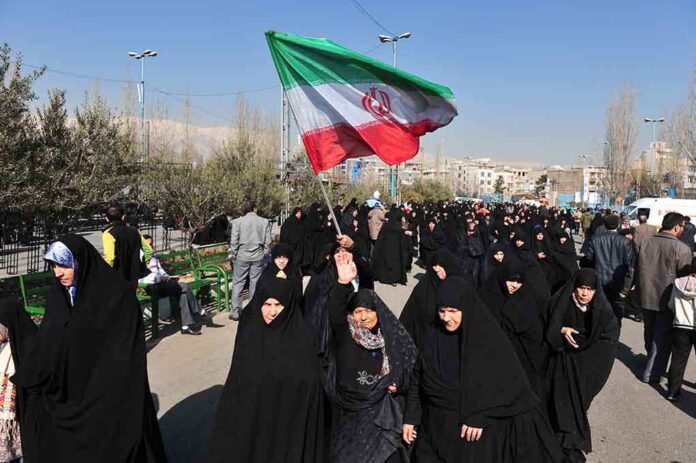
As Iran teeters on the brink of nationwide unrest, Ayatollah Khamenei reportedly prepares to flee to Russia, a move that underscores the regime’s growing instability.
Story Snapshot
- Ayatollah Khamenei has a contingency plan to escape to Moscow if protests intensify.
- The plan includes a mapped escape route and securing $95 billion in assets.
- Protests in Iran are driven by economic hardship and have spread to major cities.
- The current situation is reminiscent of Bashar al-Assad’s 2024 flight to Russia.
Khamenei’s Contingency Plan
Iran’s Supreme Leader Ayatollah Ali Khamenei has reportedly put in place a contingency “Plan B” to flee to Moscow if the escalating protests in Iran become uncontrollable. With a close circle of fewer than 20-24 aides and family members, including his son Mojtaba Khamenei, the plan hinges on the possibility that Iran’s security forces might defect or fail to suppress the demonstrators. The plan includes mapped escape routes and securing $95 billion in assets, channeling past experiences like Bashar al-Assad’s 2024 escape to Russia.
The contingency plan stems from intelligence sources amid protests fueled by economic hardships in major Iranian cities like Qom. The decision to potentially seek refuge in Russia is influenced by cultural affinities and the strong alliance with Russian President Vladimir Putin, echoing Assad’s previous collapse and flight to Moscow. This move highlights the fragility of Khamenei’s regime, especially as the country faces mounting economic woes and public dissent.
Historical Context and Recent Developments
The Islamic Republic of Iran, established in 1979, has faced repeated waves of protests, including the 2009 Green Movement and the 2019 fuel riots. More recently, the 2022 Mahsa Amini protests marked significant unrest against the regime. Khamenei, the Supreme Leader since 1989, has maintained control through the IRGC, Basij, and army, but recent events, such as the 2025 12-day war with Israel, have strained his leadership. Similar to Assad’s strategic exit, Khamenei’s plan is poised as a last resort to maintain regime survival amid potential defections and internal fractures.
The story broke on January 5, 2026, highlighting the mapped logistics and assets involved in the escape plan. Despite the detailed preparation, the plan remains conditional on the escalation of unrest. As of January 6, no activation of the plan has been reported, although protests continue to intensify with accusations of live ammunition use by security forces.
Impact and Implications
The potential execution of Khamenei’s escape plan signals vulnerability within the regime and could lead to a surge in protests if the information becomes public. In the short term, this could destabilize the Iranian government’s control, while in the long term, it might lead to a power vacuum or scramble for succession, potentially involving Khamenei’s son Mojtaba. The situation could also weaken Iran’s regional influence, particularly impacting its Shi’ite allies like Hezbollah and Hamas.
Economically, the flight of assets amounting to $95 billion would drain Iran’s resources, exacerbating the already strained economy. Socially, the regime’s legitimacy continues to erode amid ongoing hardships. Politically, the risk of defection among the IRGC and other security forces could further destabilize the regime’s hold on power, threatening the overall stability of the region.
Expert Perspectives
Ex-Israeli intelligence officer Beni Sabti has commented that Russia is the only viable refuge for Khamenei, with President Putin likely willing to provide sanctuary due to cultural and geopolitical alignments. This analysis reflects the frailty of Khamenei’s regime post-war and the strategic considerations involved in the escape plan. Right-leaning outlets have amplified the narrative of a “shaking” regime, while centrist perspectives have noted the regime’s survival mode without confirming an imminent collapse.
Despite the sensational framing by some media outlets, the core of the story remains a preparatory plan rather than an indication of the Islamic Republic’s immediate downfall. The intelligence sources cited across multiple reports provide a consistent narrative of the regime’s contingency measures, though the plan’s execution remains uncertain without independent verification.