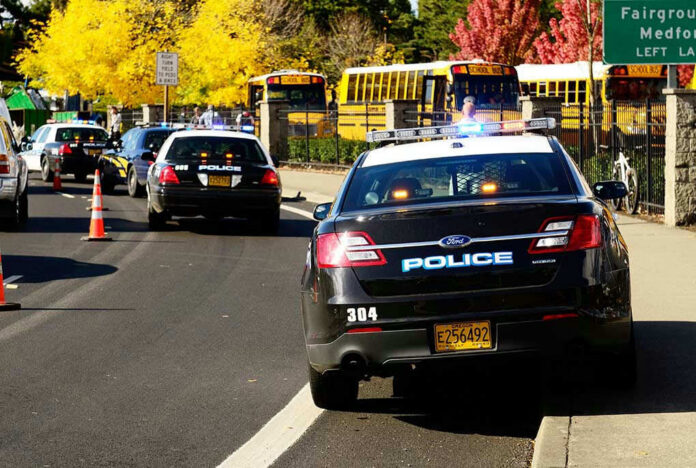
The most unnerving detail wasn’t the knife—it was the timing: lunchtime, feet from a primary school gate, and the first response looked like a counter-terror deployment.
Quick Take
- A stabbing unfolded on Bridge Road in Alum Rock, Birmingham, beside Rosary Catholic Primary School, a nursery, and a Catholic church.
- West Midlands Police received multiple 999 calls around 12:06 pm; armed officers responded and arrested a 32-year-old man at the scene.
- A man suffered critical injuries and later died, prompting a murder investigation; a woman was also injured.
- Schools locked down quickly; police emphasized containment while forensics and CCTV review began.
A Midday Street Turns Into a Crime Scene in Minutes
Bridge Road is the kind of residential stretch most people associate with school pickup routines and church foot traffic, not blue forensic tents. Around noon on March 3, 2026, that rhythm broke. Reports described a violent attack that appeared to begin inside nearby flats—screaming, blood, confusion—then spilled onto the street outside Rosary Catholic Primary School and next to a community nursery and Catholic church. Multiple emergency calls hit police at about 12:06 pm.
West Midlands Police sent armed officers, and witnesses described a scene that felt “siege-like,” the kind of heavy presence that immediately triggers a particular fear: if firearms teams are here, what do they think they’re dealing with? That question matters because it shapes community behavior in real time—parents start imagining the worst, rumors fill the gaps, and normal skepticism gets replaced by raw adrenaline. Police arrested a 32-year-old man at the scene.
The Lockdown Decision That Parents Rarely See Up Close
Schools and the nursery locked down fast, with staff keeping children inside while police established cordons. That is the quiet success story in this mess: boring protocol executed under pressure. Adults often dismiss lockdowns as theater until the day they happen on your street. Reports indicated no children witnessed the violence, a crucial detail because psychological exposure can haunt a community for years, even when physical harm is avoided.
Ambulances, paramedics, a specialist trauma team, and an air ambulance responded. The male victim received advanced life support for serious injuries. The woman’s injuries were described as less severe. Later, after the man died, police launched a murder investigation. That shift changes everything—investigators treat the scene and timelines differently, the standard for charging hardens, and the public appetite for answers becomes less patient and more demanding.
Counter-Terror Presence: What It Signals, and What It Doesn’t
Some coverage emphasized counter-terror involvement or a counter-terror-style response. Readers should treat that carefully. Armed officers can appear for many reasons, including the basic risk calculation of “bladed suspect, crowded area, near a school.” In modern Britain, the shadow of past attacks means police often plan for the worst even when the facts point to ordinary criminal violence. Preparedness is not proof of motive.
That distinction matters for social stability, especially in diverse neighborhoods such as Alum Rock. Witness chatter about a suspect speaking a “different language” can ignite speculation, and speculation can harden into accusations before a single verified fact lands. Councillor John Cotton publicly urged people to avoid speculation, and that is the right instinct. Conservative common sense says: hold the line on order and accountability, but don’t outsource truth to rumor.
The Bystander Moment Everyone Will Argue About
One detail lingered: a good Samaritan reportedly tried to intervene with a van, then fled over a fence as the situation escalated and the suspect ran into a building. That snapshot captures the moral chaos of sudden violence. People want heroes to act decisively, but real-life intervention carries real-life consequences—legal, physical, and psychological. The smarter question isn’t “why didn’t he do more?” It’s “why did this happen here at all?”
Communities learn from these moments, and not always in healthy ways. Some residents will decide to look the other way next time, concluding it’s safer not to get involved. Others will demand harder policing. From a conservative perspective, the goal is to strengthen the expectation that citizens cooperate with law enforcement—call, witness, report—without turning every civilian into a self-appointed enforcer who escalates risk around kids and families.
What Investigators Do First When Motive Is Unknown
Police said they were reviewing CCTV and appealing for witnesses. That is the backbone of these cases: build a minute-by-minute timeline, establish who was where, and test every witness account against video, phone data, and forensics. The early claim that the incident was “contained” signals investigators didn’t see an immediate ongoing threat, but it doesn’t answer the questions people actually ask at dinner: Was it targeted? Random? Domestic? Gang-related?
Alum Rock’s reputation—deprivation, tension, occasional knife-crime spikes—adds a combustible backdrop. Residents can feel insulted when outsiders treat a neighborhood as a stereotype, yet patterns exist for a reason. The responsible approach holds both truths: treat this case as a specific act by specific people, while also admitting that high-crime conditions don’t materialize from nowhere. Policy choices, policing priorities, and cultural expectations about violence all play roles.
The Aftermath: Reassurance Patrols and the Long Memory of Place
After the cordons and the blue tents come down, the street still remembers. Parents will replay where their child stood at lunchtime. Churchgoers will scan doorways they used to ignore. Police promised extra officers for reassurance, and that matters in the short term; visible order dampens fear and deters opportunistic trouble. The long-term test is whether leaders translate shock into sustained prevention, not temporary optics.
Counter-Terror Police Respond to Stabbing Near Catholic Primary School in U.K. https://t.co/ZiJd4CNkdg
— The Gateway Pundit (@gatewaypundit) March 4, 2026
Public safety near schools isn’t a partisan toy; it’s the baseline of a functioning community. The practical conservative demand is straightforward: enforce laws against violent offenders, support capable policing, and refuse the reflex to politicize tragedy before facts are in. This case will turn on evidence—CCTV, forensics, credible witnesses—not vibes. The community deserves the truth, delivered firmly, and followed by consequences that actually deter the next knife.
Sources:
Armed Police Respond After Birmingham School Stabbing
brimingham primary school birmingham armed counter terror police air ambulance
man stabbed and woman hurt in terrifying knife attack by primary school
man arrested after stabbing outside catholic church and school in birmingham