
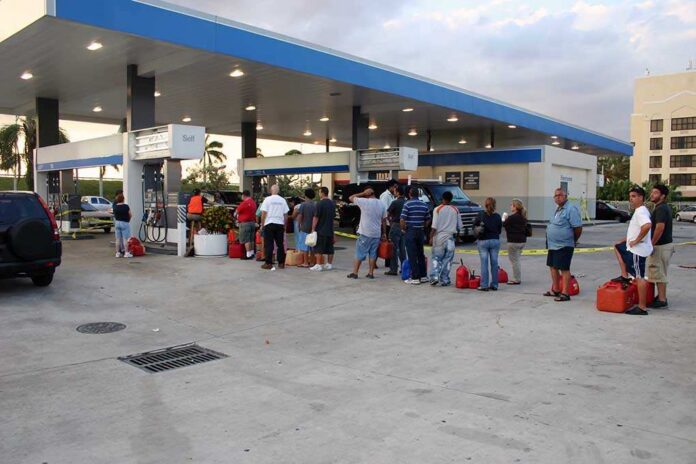
A 20-day paperwork switch in Washington can change what goes into your tank, how fast fuel moves, and what you pay—especially when a war squeezes the world’s oil chokepoint.
Quick Take
- The EPA approved an emergency waiver that temporarily relaxes summer gasoline rules and enables broader E15 and E10 sales starting May 1, 2026.
- The waiver runs through May 20, 2026, the maximum window allowed under the Clean Air Act, with possible extensions if supply tightness continues.
- The policy targets higher fuel supply and lower pump prices as the Iran war disrupts global oil flows through the Strait of Hormuz.
- “Boutique fuel” requirements get sidelined, letting a single common vapor-pressure standard simplify refining and distribution.
An emergency waiver built for a crisis, not a campaign slogan
EPA Administrator Lee Zeldin announced an emergency fuel waiver that lifts key summer gasoline restrictions nationwide, timed to begin May 1, 2026. The immediate goal is simple: increase supply fast as geopolitical disruption pushes energy costs higher. The waiver temporarily opens the door wider for E15—gasoline blended with 15% ethanol—and eases federal impediments affecting E10 as well, expanding what retailers can sell during the tightest driving months.
The biggest tell that this is a true “systems” move, not a talking-point tweak, sits in the fine print: the EPA also waives federal enforcement of state boutique fuel requirements during the emergency window. Boutique fuels fragment the market into mini-recipes; refiners must run special blends for specific regions, which adds cost and reduces flexibility when supply lines get stressed. A single, common Reid Vapor Pressure standard of 10 psi aims to unclog that bottleneck quickly.
Why summer gasoline rules exist, and why they pinch when supply gets tight
Summer fuel regulations trace back decades under the Clean Air Act, requiring a shift to lower-volatility blends during hotter months because certain gas formulations evaporate more readily and can contribute to smog. The normal seasonal switch—commonly associated with the June-to-mid-September period—creates a predictable “refinery juggling act.” When global supply shocks hit, that juggling act turns into a choke point: fewer interchangeable barrels, fewer routing options, and higher odds that a local outage becomes a regional price spike.
E15 sits at the center of this waiver for a practical reason: it exists already, but regulatory boundaries limit where it can be sold in summer. More than 3,000 stations offer E15 nationwide, yet without emergency action, roughly half the country faces warm-season restrictions that narrow distribution. The waiver doesn’t magically create new refineries or pipelines; it frees up the legal ability to sell an available product more broadly, which can matter when every incremental gallon counts.
The geopolitical spark: oil chokepoints punish consumers faster than Congress can vote
The administration links the emergency to the Iran war and the effective closure of the Strait of Hormuz, a strategic corridor that can rattle global markets when ships can’t move freely. Domestic prices respond to global disruptions with brutal speed, and the reporting around the announcement pegged the national average near $3.98 per gallon, with California, Hawaii, and Washington already above $5. Those numbers do more than irritate drivers; they raise shipping costs and seep into grocery bills.
Energy politics often gets reduced to personalities, but this episode reads like an old-fashioned supply problem. The Trump administration paired the fuel waiver with other supply-side moves described in the coverage, including releasing 173 million barrels from the Strategic Petroleum Reserve, waiving the Jones Act to enable foreign ships to move fuel between U.S. ports, and lifting Russian oil sanctions. Voters can argue the wisdom of each step, but the strategy clearly prioritizes immediate price relief and logistical flexibility.
How the waiver works in practice: a 20-day window with a bigger message
The Clean Air Act allows emergency fuel waivers for limited periods, and the EPA set this one through May 20, 2026—twenty days, the statutory maximum—while signaling openness to extensions if conditions warrant. That detail matters for anyone expecting a permanent rule change: this is a temporary bridge, not a new highway. The EPA says it coordinated with federal partners, including the Department of Energy, to determine that the waiver serves the public interest.
Consumers should read the promise of “lower prices” as directional, not guaranteed. Fuel markets react to many forces—crude prices, refining capacity, pipeline constraints, local taxes, and regional demand surges. Still, loosening boutique requirements and widening E15/E10 availability can reduce scarcity premiums in stressed areas by letting suppliers substitute and reroute product. Common sense says fewer custom blends and more legal product options generally produce a calmer market than rigid, fragmented rules during a shock.
The trade-offs: consumer relief first, with environmental guardrails under scrutiny
Supporters frame the waiver as a pro-family, pro-worker decision: affordable and reliable energy underpins commuting, small-business deliveries, and household budgets. That aligns with conservative priorities that treat energy affordability as a kitchen-table issue, not an abstract policy debate. Critics, when they surface, typically focus on air-quality concerns tied to volatility rules. The EPA’s position says environmental protections remain in place despite the temporary relaxation, but the short-term nature of the waiver suggests the agency expects scrutiny.
Trump waives summer gasoline regulations to ease fuel prices
Source: CBS News https://t.co/vlACGIsUFQ— Fred S Loquasto (@FLoquasto) March 26, 2026
The unresolved question sits beyond May 20: whether the waiver gets extended and whether the market needs it. If Hormuz stays constrained, refiners will still face the same global math, and Washington will keep reaching for the levers that move fastest. If the crisis eases, the regulatory clock snaps back to normal. Either way, the episode spotlights an unglamorous truth: in energy, flexibility beats perfection when the world catches fire.
Sources:
https://www.cbsnews.com/news/gas-prices-epa-e15-waiver-summer-fuel-rules/
https://www.livenowfox.com/news/trump-administration-waives-gasoline-regulations-lower-prices
https://ethanolproducer.com/articles/epa-issues-emergency-waivers-for-summer-e15-sales