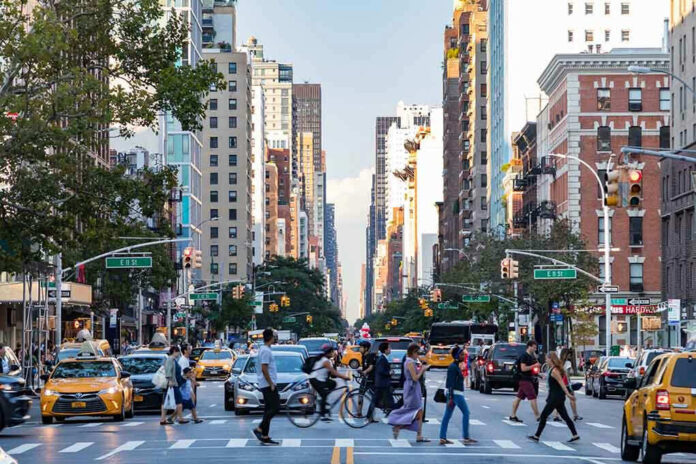
New York City, the so-called capital of innovation, is finally letting driverless cars roam its legendary streets—if, and only if, there’s a human being glued to the driver’s seat, ready to babysit the almighty robotaxi every inch of the way.
At a Glance
- Waymo begins testing self-driving cars in NYC, but only with human “safety monitors” behind the wheel.
- State law still prohibits fully driverless vehicles, despite years of AV hype and Big Tech lobbying.
- Testing is limited to data collection and mapping, with no public ride-hailing yet available.
- Regulators demand $5 million insurance and rigorous training for each operator.
NYC’s Dance with Driverless Tech: All Hype, No Trust
Waymo, the Google-alphabet-salad company making headlines for its robotaxis in the sun-drenched streets of Phoenix and San Francisco, has now rolled into Manhattan and Brooklyn. Or rather, they’ve tiptoed in—because here in New York, the supposed vanguard of progress, bureaucrats still require a human “safety operator” behind the wheel at all times. That means these “autonomous” cars are about as independent as a child on training wheels—don’t let the PR fool you. The vehicles aren’t even picking up passengers yet. Instead, they’re just crawling around the city, mapping streets and collecting data, all while a Waymo employee sits ready to slam the brakes if the artificial intelligence loses its nerve or, God forbid, mistakes a pothole for a portal to the underworld.
Waymo wants the world to believe it’s breaking new ground, but the truth is that state law blocks anything resembling an actual driverless future. If you’re waiting for a robotaxi to cruise by and whisk you to your Broadway show, don’t hold your breath. Two bills that could even allow real self-driving vehicles to operate are stuck in committee, gathering dust while lobbyists and politicians do their endless dance. For now, every Waymo car in the city is just another car—with a very expensive, very bored human in the driver’s seat, watching the robot try not to embarrass itself.
Regulation Nation: Big Promises, Bigger Insurance, and Zero Change
It’s not just the human babysitter requirement. New York’s regulatory regime is a monument to bureaucratic excess: every test car must carry a $5 million insurance policy and each “safety operator” has to pass a training gauntlet worthy of a NASA astronaut. The city’s Department of Transportation, famous for its love of red tape, is wielding its power like a bouncer at an exclusive club—nobody gets in unless every single box is checked, and then double-checked. Waymo’s so-called “Road Trip” initiative—sending fleets to map cities across America—has run into the buzzsaw of New York’s ultra-strict rules, and the company knows it. If they want real driverless cars in this city, they’ll need a full-blown legislative overhaul, not just a press release and a few glossy ads.
This level of government intervention is supposedly all about “public safety,” but the real result is stagnation. While cities like Phoenix and Austin are already offering actual robotaxi rides, New Yorkers get to watch from the sidelines, stuck with the same old gridlock, the same old taxi medallion mafia, and the same tired excuses from lawmakers who talk innovation but act like it’s 1950. It’s the same story every time: government promises the future, then ties it down with insurance mandates, training certifications, and endless committees that accomplish nothing but justify their own existence.
What’s at Stake: Jobs, Trust, and the Future of the City
Let’s be clear: if and when the legal handcuffs ever come off, the impact on local jobs and city life will be seismic. Every Uber driver, every yellow cab operator, every delivery person has a target painted on their back by this technology. Waymo brags that its cars outperform humans and cut down on accidents, but the company’s record is far from spotless—recent recalls and software mishaps in other cities have shown that even the best AI can get confused when reality doesn’t match the training data. And in New York, where traffic is a contact sport and pedestrians play by their own rules, good luck convincing anyone that robots are up to the challenge.
For now, the public is still skeptical, and rightfully so. Community organizations and local colleges have been dragged into the mix to “build trust” and train the next generation of AV technicians, but the fact remains: real New Yorkers want safe streets, reliable jobs, and less government interference in their daily lives. They’re tired of being guinea pigs for tech giants who promise the moon but can’t even deliver a taxi without a backup driver. Until New York’s lawmakers get serious about either embracing or rejecting this technology—instead of just regulating it to death—nothing meaningful will change.